£2.3m to turn Leeds flats into 'decent homes'
Council chiefs in Leeds have been handed £2.3m to refurbish three inner city tower blocks they had earmarked for sale.
Date: 07 April 2008
By David Marsh
Council chiefs in Leeds have been handed £2.3m to refurbish three inner city tower blocks they had earmarked for sale.
The Government money will be used to improve the Lovell Park multi-storey flats on the Little London estate.
In 2005 when the council unveiled its plans for a £95m Private Finance Initiative (PFI) scheme to regenerate Little London, it proposed that the Lovell Park Heights, Grange and Towers blocks be sold to a developer who would renovate them for sale or rent.
The suggested sale was strongly opposed by the Little London Tenants and Residents Association, which did not want the tenants of the 297 flats to lose their homes.
Having gained Government approval for the £95m regeneration scheme, the council put the sale proposals on hold to consider other options for the three blocks.
Councillors agreed to pursue other sources of cash and has now been awarded the £2.3m from the Government's Decent Homes funding to improve the blocks.
Coun Les Carter, executive councillor for housing, was delighted the council had been able to win the extra money.
He said: "Our success in securing the £95m comprehensive regeneration project will be further boosted by this additional funding which will bring the Lovell Park multi-storey tower blocks up to decent standard.
"I am pleased that we have been able to take on board the residents' views following the consultation, and I am sure that the people of Little London will notice very real improvements to their neighbourhood when work gets under way."
Decent Homes is a government target that all council and housing associations must achieve by 2010. A Decent Home is defined as one that is warm, weatherproof and has reasonably modern facilities.
The £95m comprehensive regeneration for Little London has a number of key targets including construction of 125 new council homes, a range of new private sector homes and up to 40 per cent of new homes to fall into the "affordable" range.
Monday, June 23, 2008


Monday, October 29, 2007
Lovells story in Yorkshire Evening Post
This story appeared in the Yorkshire Evening Post on 12 October 2007.
Tenants get boost in fight to save flats
By DAVID MARSH
Municipal Reporter
http://www.yorkshireeveningpost.co.uk/news/Tenants-get-boost-in-fight.3374167.jp
TENANTS fighting plans to sell three council tower blocks to private developers have scored a victory.Council chiefs have now decided to seek Government cash to improve the three Lovell Park tower blocks on the Little London estate in Leeds.
And Andrew Coley, chairman of Little London Tenants and Residents Association, today hailed the council’s change of heart as “fantastic news.”
Two years ago Leeds City Council revealed plans for a £95m Private Finance Initiative (PFI) scheme to regenerate Little London. It proposed that as part of the project the three high-rise blocks could be sold to a specialist developer who would renovate them for sale or rent.
The suggested sale was strongly opposed by the association, who argued that no tenants should lose their homes as part of the regeneration.
After the Government last year approved the PFI, council bosses agreed to put the sale proposal on hold and consider other options for the blocks.
They have now decided to apply to the Government for Decent Homes funding to carry out major improvements to the flats.
Mr Coley said: “As an association we always said we didn’t want to see any demolitions or any sale of people’s homes.
“We wanted the community to be kept together and for everyone to benefit from investment. It is fantastic news that the council has decided to seek the decency funding.
“Apart from day-to-day repairs, there has been no capital spending on the Little London flats since PFI was first suggested in 2001. We back the council 100 per cent in trying to get this money.”
Process
Coun Les Carter, executive member for neighbourhoods and housing, commented: “This is the start of a process. We are by no means guaranteed the funding from Government, but this shows that the council is ready to take action to secure a decent future for Lovell Park flats.”
Coun Penny Ewens (Lib Dem, Hyde Park and Woodhouse) said: “I am aware that residents would like to see decent homes improvements and I am very pleased about this news.”
Coun Barry Anderson, who chairs West North West Homes, the council’s arms-length management organisation responsible for the estate, said: “We’ll be writing to all the residents to let them know the plan, and hope that we are able to bring good news back from our discussions with the Government.”
Tenants get boost in fight to save flats
By DAVID MARSH
Municipal Reporter
http://www.yorkshireeveningpost.co.uk/news/Tenants-get-boost-in-fight.3374167.jp
TENANTS fighting plans to sell three council tower blocks to private developers have scored a victory.Council chiefs have now decided to seek Government cash to improve the three Lovell Park tower blocks on the Little London estate in Leeds.
And Andrew Coley, chairman of Little London Tenants and Residents Association, today hailed the council’s change of heart as “fantastic news.”
Two years ago Leeds City Council revealed plans for a £95m Private Finance Initiative (PFI) scheme to regenerate Little London. It proposed that as part of the project the three high-rise blocks could be sold to a specialist developer who would renovate them for sale or rent.
The suggested sale was strongly opposed by the association, who argued that no tenants should lose their homes as part of the regeneration.
After the Government last year approved the PFI, council bosses agreed to put the sale proposal on hold and consider other options for the blocks.
They have now decided to apply to the Government for Decent Homes funding to carry out major improvements to the flats.
Mr Coley said: “As an association we always said we didn’t want to see any demolitions or any sale of people’s homes.
“We wanted the community to be kept together and for everyone to benefit from investment. It is fantastic news that the council has decided to seek the decency funding.
“Apart from day-to-day repairs, there has been no capital spending on the Little London flats since PFI was first suggested in 2001. We back the council 100 per cent in trying to get this money.”
Process
Coun Les Carter, executive member for neighbourhoods and housing, commented: “This is the start of a process. We are by no means guaranteed the funding from Government, but this shows that the council is ready to take action to secure a decent future for Lovell Park flats.”
Coun Penny Ewens (Lib Dem, Hyde Park and Woodhouse) said: “I am aware that residents would like to see decent homes improvements and I am very pleased about this news.”
Coun Barry Anderson, who chairs West North West Homes, the council’s arms-length management organisation responsible for the estate, said: “We’ll be writing to all the residents to let them know the plan, and hope that we are able to bring good news back from our discussions with the Government.”
Lovells Flats saved from privatisation! October 2007
 On 10 October (2007) Leeds City Council informed tenants of three Lovell Park high-rise blocks of flats in Little London that it would no longer seek to sell off the flats to a private developer, and would instead retain them as council homes.
The decision was announced to an open meeting of the newly-formed Lovell Park Flats Tenants and Residents Committee at the Little London Community Centre.
This is magnificent victory for tenants, and the small number of leaseholders, who have fought the proposed sell off since Leeds City Council announced its plans in early 2006. Thanks to dogged campaigning, tenants decisively rejected the sale of their homes during the February 2006 consultation. Initially, Leeds City Council ignored their wishes and in May 2006 passed a resolution to press on with the sale.
However, following the public embarassment to senior councillors of the extensive television and newspaper coverage of the injustice to the Lovells tenants, and a 500 signature-strong petition from local residents calling for regeneration to 'benefit all, not some', the Council agreed to 'look again' at the options and consult tenants.
Yet again, the Council failed to communicate with anyone in the Lovells flats, and following a newspaper article in December 2006, tenants were forced to endure another agonising and worrying period of silence on the matter until this month (October).
At the meeting with tenant representatives from the Lovells, an officer from the housing management company, West North West Homes, finally gave tenants the news they had always wanted to hear: that the proposed sale of 297 flats to be refurbished as private flats was off, and that instead West North West Homes and Leeds City Council would apply for extra cash from central government to bring the flats up to the Decent Homes Standard.
Despite the good news, the discussions with housing officers confirmed what the Save Little London Campaign has been saying all along - that the Lovells are viable council flats in a great location with many years of public service left in them. In other words, Leeds City Council was not telling tenants the truth when it said that the flats were beyond saving as council homes and that the council could not continue to let these flats in the long term because of falling demand and high turnover.
The simple truth is that Leeds City Council originally decided to sell off the flats for a variety of reasons that bore little resemblance to their official explanation. Housing officers admitted as much at the meeting when they explained that the private sector market had "moved on" in recent years to favour "new build schemes" and therefore a refurbishment scheme was unlikely to attract much interest from developers.
So what is the future for the Lovells now?
Leeds City Council and West North West Homes will hopefully succeed in getting extra funding from government to carry out Decent Homes repairs. This means that every flat that needs it will get double glazing, but only those flats with outstanding repairs and renewal issues that fail the Decency standard will actually have anything spent on them. The Decency threshold is also pretty low in any case.
In other words, even though the flats look like being saved, we are extremely concerned that the housing management company and the Council will not have / or make available enough funding to get the flats refurbished to a level of human decency. The situation in the Lovells at the moment is a disgrace with drug dealing and addiction causing major security and health problems. Tenants standard of living is shocking.
Little London PFI in local press, 3 July 2007
This was printed in the Yorkshire Evening Post on 3 July 2007
'Build more council homes' plea to chiefs
By David Marsh
http://www.yorkshireeveningpost.co.uk/news/39Build-more-council--homes39.2997882.jp
HOUSING chiefs are being urged to build more council houses as part of a plan to regenerate an inner city Leeds neighbourhood.
The council has published a draft blueprint – currently out for public consultation – that will help guide plans to reshape the Little London estate on the edge of the city centre.
A key plank of the regeneration is a scheme to build hundreds of new homes under a Government-backed Private Finance Initiative (PFI).But there are fears the initiative will do nothing to tackle the affordable housing crisis facing the city and is more of a device to "gentrify" the 1960s-built council estate.
In a document prepared as part of the public consultation, Leeds University academic Stuart Hodkinson, who is also a community advisor to the Little London Tenants and Residents Association, says the council's draft scheme would see a reduction of between 15 and 27 local authority homes.
He also points out there is a questionmark over the future of three multi-storey blocks – which the council is considering selling to a private developer – and adds: "Overall, this represents a major change in the mix of housing tenures towards the free market and away from social housing."
Mr Hodkinson said the number of council homes in Leeds was expected to fall by up to 15,000 over the next 10 years, which would add to the shortage of affordable housing.
Desire
He said: "Leeds – and Little London – desperately needs to retain its existing social rented stock."
Noting that the draft blueprint says that one of the aims is to "maximise the market potential of the area," Mr Hodkinson says:
"This speaks more of a desire to gentrify the community as part of the city centre growth strategy."
He acknowledges that the blueprint – called a development framework – has much to commend it including housing improvements, proposals to make the estate safer and more attractive, better shops and a new community centre.
Mr Hodkinson adds: "It is very much hoped that this framework does not become watered down during the competitive dialogue and final negotiations of the PFI procurement process."
Public consultation runs until the end of this month, and the council will consider all the comments made.
Last Updated: 03 July 2007 12:37 PM
'Build more council homes' plea to chiefs
By David Marsh
http://www.yorkshireeveningpost.co.uk/news/39Build-more-council--homes39.2997882.jp
HOUSING chiefs are being urged to build more council houses as part of a plan to regenerate an inner city Leeds neighbourhood.
The council has published a draft blueprint – currently out for public consultation – that will help guide plans to reshape the Little London estate on the edge of the city centre.
A key plank of the regeneration is a scheme to build hundreds of new homes under a Government-backed Private Finance Initiative (PFI).But there are fears the initiative will do nothing to tackle the affordable housing crisis facing the city and is more of a device to "gentrify" the 1960s-built council estate.
In a document prepared as part of the public consultation, Leeds University academic Stuart Hodkinson, who is also a community advisor to the Little London Tenants and Residents Association, says the council's draft scheme would see a reduction of between 15 and 27 local authority homes.
He also points out there is a questionmark over the future of three multi-storey blocks – which the council is considering selling to a private developer – and adds: "Overall, this represents a major change in the mix of housing tenures towards the free market and away from social housing."
Mr Hodkinson said the number of council homes in Leeds was expected to fall by up to 15,000 over the next 10 years, which would add to the shortage of affordable housing.
Desire
He said: "Leeds – and Little London – desperately needs to retain its existing social rented stock."
Noting that the draft blueprint says that one of the aims is to "maximise the market potential of the area," Mr Hodkinson says:
"This speaks more of a desire to gentrify the community as part of the city centre growth strategy."
He acknowledges that the blueprint – called a development framework – has much to commend it including housing improvements, proposals to make the estate safer and more attractive, better shops and a new community centre.
Mr Hodkinson adds: "It is very much hoped that this framework does not become watered down during the competitive dialogue and final negotiations of the PFI procurement process."
Public consultation runs until the end of this month, and the council will consider all the comments made.
Last Updated: 03 July 2007 12:37 PM
Little London PFI scheme out for tender, July 2007
On 24 July (2007), Leeds City Council finally advertised the tender for the Little London PFI housing regeneration scheme. This means that the public sector contract for the proposed regeneration scheme has now been advertised by the Council to the private sector across the European Union, and that Leeds City Council is now officially in the procurement phase of the PFI scheme.
Any company / consortium interested in bidding for the Little London scheme had to send in what is called a 'Pre-Qualification Questionnaire' (PQQ) by the 4 September 2007. A PQQ asks a potential bidder a number of questions about their economic and financial standing and their technical and professional ability in order to determine whether they can proceed to the next stage.
The full tender advertisement is below, or download it here. As you can see, it is a very technical document that only professionals will understand!!! However, it very clearly states that Leeds City Council is seeking to award a single contract for both the Little London PFI scheme, and the Beeston Hill and Holbeck PFI scheme, to a prospective PFI consortium. Click here to remind yourself how PFI works.
The tender advert also makes clear that tenants in Beeston Hill and Holbeck face a far worse situation than Little London tenants, because Leeds City Council is proposing to demolish around 600 homes and convert a further 120 homes into more suitable accommodation (which will mean more homes being lost). In their place, the Council is proposing to build approximately 200 new council homes, and a massive 500 new private homes. In other words, a net loss of council housing by at least 400 homes, and the direct replacement of public housing with private housing.
Little London PFI Scheme Tender Document (click to download PDF version)
Tender: Leeds: housing services
Articles / Tenders: Other Services Date: Jul 24, 2007 - 08:14 AM
The deadline for this government tender / public sector contract notice is 04/09/2007
UK-Leeds: housing services
2007/S 140-173257
CONTRACT NOTICE
Works
SECTION I: CONTRACTING AUTHORITY
I.1) NAME, ADDRESSES AND CONTACT POINT(S):
Leeds City Council, Procurement Unit, 4th Floor West, Civic Hall, Calverly Street, Contact: Greg O'Halloran, Attn: Greg O'Halloran, UK-Leeds LS1 1UR. Tel. 0113 3950707. E-mail: mailto:greg.o. Fax 0113 2478862.
Internet address(es):
General address of the contracting authority: http://www.leeds.gov.uk/.
Address of the buyer profile: http://scms.alito.co.uk/.
Further information can be obtained at: As in above-mentioned contact point(s). Specifications and additional documents (including documents for competitive dialogue and a dynamic purchasing system) can be obtained at: As in above-mentioned contact point(s).
Tenders or requests to participate must be sent to: As in above-mentioned contact point(s).
I.2) TYPE OF THE CONTRACTING AUTHORITY AND MAIN ACTIVITY OR ACTIVITIES:
Regional or local authority.
General public services.
Housing and community amenities.
The contracting authority is purchasing on behalf of other contracting authorities: no.
SECTION II: OBJECT OF THE CONTRACT
II.1) DESCRIPTION
II.1.1) Title attributed to the contract by the contracting authority:
Little London and Beeston Hill and Holbeck Housing Private Finance Initiative Regeneration Project.
II.1.2) Type of contract and location of works, place of delivery or of performance:
Works.
Main site or location of works: Leeds.
NUTS code: UKE42.
II.1.3) The notice involves:
A public contract.
II.1.4) Information on framework agreement:
II.1.5) Short description of the contract or purchase(s):
Leeds City Council is seeking to enter into a Housing Revenue Account Private Finance Initiative contract or contracts for the refurbishment, demolition and replacement and associated environmental improvements of homes in the Little London area of Leeds and (subject to government funding approval) in the Beeston Hill and Holbeck area of South Leeds. The project is anticipated to encompass both a Private Finance Initiative contract or contracts (as outlined above) and development agreement(s) for the redevelopment of certain sites in both Little London (which will include the redevelopment of the Little London neighbourhood centre) and the Beeston Hill and Holbeck areas. It is anticipated that the PFI contract(s) will be for a period of around 20 to 30 years (including the works period). The contractor will be responsible throughout the duration of the contract for the provision of repairs, maintenance, cleaning and caretaking services to both refurbished and new dwellings. Leeds City Council expects bidders to propose solutions to satisfy its output based specification. It should be noted that funding approval is still required in respect of the Beeston Hill and Holbeck aspect of the project. Further information is contained in the Memorandum of Information available from the address in I.1.
II.1.6) Common procurement vocabulary (CPV):
70333000, 70331000, 50700000, 45111000, 45211000, 45453100.
II.1.7) Contract covered by the Government Procurement Agreement (GPA):
Yes.
II.1.8) Division into lots:
Yes.
Tenders should be submitted for: all lots.
II.1.9) Variants will be accepted:
Yes.
II.2) QUANTITY OR SCOPE OF THE CONTRACT
II.2.1) Total quantity or scope:
A design, build, finance and operate contract with an overall capital value of approximately 154 000 000 GBP (75 000 000 GBP in respect of Little London and 79 000 000 GBP in respect of Beeston Hill and Holbeck) is envisaged.
The procurement is to be divided into 3 'lots', the first in respect of Little London only (“Lot 1”), the second in respect of Beeston Hill & Holbeck only (“Lot 2”) and the third encompassing both Little London and Beeston Hill & Holbeck (“Lot 3”). Bidders are required to bid for each of the 3 lots (subject to the right of Leeds City Council to discontinue or postpone the procurement of any of the lots) though they should note that Leeds City Council's preferred option at this stage is to award a contract in respect of Lot 3 (subject to receiving government approval in respect of Beeston Hill and Holbeck).
Within the Little London area, the project is anticipated to consist of the refurbishment of around 922 Council homes (subject to technical due diligence), demolition of two blocks of flats (102 units) and around 40 maisonettes, construction of approximately 125 new homes for Leeds City Council and the undertaking of associated environmental improvements. It is also expected that the contractor will enter into a development agreement for the provision of approximately 90 new homes for private sale, a proportion of which will be affordable or low cost housing, and for the redevelopment of the current neighbourhood centre (including the provision of shops, community centre and housing office).
Within the Beeston Hill and Holbeck area it is anticipated that the project will consist of the refurbishment of approximately 450 Council homes (subject to technical due diligence), demolition of around 600 properties, conversion of around 120 homes into more suitable accommodation, construction of approximately 200 new homes for Leeds City Council and the undertaking of associated environmental improvements. It is also expected that the contractor will enter into a development agreement for the provision of approximately 500 new homes for private sale, a proportion of which will be affordable or low cost housing.
The number of properties to be refurbished, demolished, built and/or maintained and the scope of the services currently envisaged may change as the project progresses.
The Beeston Hill and Holbeck part of the project still requires government approval which will be sought during the initial stages of tendering. The City Council reserves the right (at any time) to discontinue or postpone the procurement of any of the lots, or to proceed with the project and to award a contract in respect of: Lot 1 only; Lot 2 only; both Lot 1 and Lot 2 (separately); or Lot 3.
Prior to entering into any development agreement, the successful bidder will need to demonstrate that its bid will provide best consideration in relation to any land to be disposed of by Leeds City Council.
Leeds City Council may include an option or variation mechanism to extend the initial contract term and/or to include additional works, services and/or supplies within the scope. Furthermore, a public works contract for new works which would be a repetition of the works provided (or to be provided) under any contract awarded pursuant to the procurement process commenced by the publication of this contract notice may be awarded by Leeds City Council without prior publication of a contract notice using the negotiated procedure in accordance with Regulation 14(1)(d)(ii) of the Public Contracts Regulations 2006.
Further details are contained in the Memorandum of Information which can be obtained from the address at I.1.
II.2.2) Options:
II.3) DURATION OF THE CONTRACT OR TIME-LIMIT FOR COMPLETION: Duration in months: 240 (from the award of the contract).
INFORMATION ABOUT LOTS
LOT NO 1
TITLE: Little London only
1) SHORT DESCRIPTION: Housing services.
2) COMMON PROCUREMENT VOCABULARY (CPV): 70333000.
3) QUANTITY OR SCOPE:
4) INDICATION ABOUT DIFFERENT DATE FOR DURATION OF CONTRACT OR STARTING/COMPLETION:
5) ADDITIONAL INFORMATION ABOUT LOTS:
LOT NO 2
TITLE: Beeston Hill and Holbeck only
1) SHORT DESCRIPTION: Housing services.
2) COMMON PROCUREMENT VOCABULARY (CPV): 70333000.
3) QUANTITY OR SCOPE:
4) INDICATION ABOUT DIFFERENT DATE FOR DURATION OF CONTRACT OR STARTING/COMPLETION:
5) ADDITIONAL INFORMATION ABOUT LOTS:
LOT NO 3
TITLE: Both Little London and Beeston Hill and Holbeck
1) SHORT DESCRIPTION: Housing services.
2) COMMON PROCUREMENT VOCABULARY (CPV): 70333000.
3) QUANTITY OR SCOPE:
4) INDICATION ABOUT DIFFERENT DATE FOR DURATION OF CONTRACT OR STARTING/COMPLETION:
5) ADDITIONAL INFORMATION ABOUT LOTS:
SECTION III: LEGAL, ECONOMIC, FINANCIAL AND TECHNICAL INFORMATION
III.1) CONDITIONS RELATING TO THE CONTRACT
III.1.1) Deposits and guarantees required:
Leeds City Council reserves the right to require deposits, bonds, or other forms of appropriate security.
III.1.2) Main financing conditions and payment arrangements and/or reference to the relevant provisions regulating them:
The terms concerning financing and payment will be set out in the contract documents. The project is being procured under the UK government Private Finance Initiative.
III.1.3) Legal form to be taken by the group of economic operators to whom the contract is to be awarded:
Contract(s) may be awarded to one or more applicants, consortia or individual members of consortia in respect of any one or more of the lots, but in the case of a consortium or individual members of a consortium liability to Leeds City Council will be joint and several.
III.1.4) Other particular conditions to which the performance of the contract is subject:
Yes.
See the pre-qualification documents which are available from the address in section I.1.
III.2) CONDITIONS FOR PARTICIPATION
III.2.1) Personal situation of economic operators, including requirements relating to enrolment on professional or trade registers:
Information and formalities necessary for evaluating if requirements are met: Suppliers may be treated as ineligible under the terms of Regulation 23 (Criteria for rejection of economic operator’s services) of the Public Contracts Regulations 2006, as detailed in the pre-qualification documents.
Further details and copies of the Pre Qualification Questionnaire can be obtained from the Supplier Contract Management System web site at http://scms.alito.co.uk. If you have any queries you can contact Greg O'Halloran, Project Procurement Officer, Corporate Procurement Unit, Legal and Democratic Services, Leeds City Council, Leeds LS1 1UR, tel. 0113 395 0707, fax 0113 2478862, email mailto:greg.o. The deadline for receipt of Pre Qualification Questionnaires is noon 4.9.2007. The selected list of tenderers will be compiled from the evaluation of the questionnaires (as set out in Articles 29- 35 of Directive 92/50/EC).
III.2.2) Economic and financial capacity:
Information and formalities necessary for evaluating if requirements are met: Please refer to Pre Qualification Questionnaire and Tender Documents.
III.2.3) Technical capacity:
Information and formalities necessary for evaluating if requirements are met: See III.2.1 above and refer to Pre Qualification Questionnaire.
III.2.4) Reserved contracts:
No.
III.3) CONDITIONS SPECIFIC TO SERVICES CONTRACTS
III.3.1) Execution of the service is reserved to a particular profession:
III.3.2) Legal entities should indicate the names and professional qualifications of the staff responsible for the execution of the service:
SECTION IV: PROCEDURE
IV.1) TYPE OF PROCEDURE
IV.1.1) Type of procedure:
Competitive dialogue.
IV.1.2) Limitations on the number of operators who will be invited to tender or to participate: Objective criteria for choosing the limited number of candidates: As stated in the pre-qualification documents available from the address in section I.1.
IV.1.3) Reduction of the number of operators during the negotiation or dialogue:
Recourse to staged procedure to gradually reduce the number of solutions to be discussed or tenders to be negotiated yes.
IV.2) AWARD CRITERIA
IV.2.1) Award criteria:
The most economically advantageous tender in terms of the criteria stated in the specifications, in the invitation to tender or to negotiate or in the descriptive document.
IV.2.2) An electronic auction will be used:
No.
IV.3) ADMINISTRATIVE INFORMATION
IV.3.1) File reference number attributed by the contracting authority:
LCC4057.
IV.3.2) Previous publication(s) concerning the same contract: No.
IV.3.3) Conditions for obtaining specifications and additional documents or descriptive document Payable documents: no.
IV.3.4) Time-limit for receipt of tenders or requests to participate: 4.9.2007.
IV.3.5) Date of dispatch of invitations to tender or to participate to selected candidates:
IV.3.6) Language(s) in which tenders or requests to participate may be drawn up: English.
IV.3.7) Minimum time frame during which the tenderer must maintain the tender:
IV.3.8) Conditions for opening tenders:
SECTION VI: COMPLEMENTARY INFORMATION
VI.1) THIS IS A RECURRENT PROCUREMENT: No.
VI.2) CONTRACT RELATED TO A PROJECT AND/OR PROGRAMME FINANCED BY EU FUNDS:
No
VI.3) ADDITIONAL INFORMATION:
Candidates should note that Leeds City Council intends to hold a bidders information day on 16.8.2007. Applicants wishing to attend should pre-register with Dayle Lynch via e-mail at dayle.lynch@leeds.gov.uk (0113 395 2835) by 13.8.2007.
Leeds City Council expressly reserves the right:
(a) not to award any contract as a result of the procurement process commenced by the publication of this notice;
(b) to make whatever changes it may see fit to the content, process, timing and structure of the tendering competition;
(c) not to evaluate any PQQ responses received after the relevant deadline;
(d) to award one or more contracts in respect of part only of the requirements covered by this contract notice;
(e) to procure the whole or any part of any lot or any combination of any lots by any other means (including by way of a new procurement process);
and
(f) to make any change to the procurement programme or any other date currently envisaged.
In no circumstance will Leeds City Council be liable for any costs incurred by any candidate participating in the procurement process.
Parties which alter their composition after submitting a response to the PQQ may be the subject of re-evaluation.
Variant bids may be permissible within the parameters to be determined in the tender documentation.
Variants will be accepted in addition to the compliant bids (as set out in the tender documentation) providing that Leeds City Council's core requirements are met and provided that they are in accordance with the contract documentation. Applicants should note that it is intended that rent collection, allocations and lettings and other tenancy management services will not form part of the project, and will be retained by the local ALMOs.
VI.4) PROCEDURES FOR APPEAL
VI.4.1) Body responsible for appeal procedures:
Official name: See section VI.4.2.
VI.4.2) Lodging of appeals:
Precise information on deadline(s) for lodging appeals: Precise information on deadline(s) for lodging appeals: Leeds City Council will incorporate a minimum 10 calendar day standstill period at the point information on the award of the contract is communicated to candidates. This period allows unsuccessful candidates to seek further debriefing from Leeds City Council before the contract is entered into. Applicants have two working days from the notification of the award decision to request additional debriefing and that information has to be provided a minimum of three working days before the expiry of the standstill period. Such additional information should be requested from the addressee in section I.1. If an appeal regarding the award of the contract has not been successfully resolved, The Public Contracts Regulations 2006 (SI 2006 No. 5) provide for aggrieved parties who have been harmed or are at risk of harm by a breach of the rules to take action in the High Court (England, Wales and Northern Ireland). Any such action must be brought promptly (generally within three months). Where a contract has not been entered into, the Court may order the setting aside of the award decision or order Leeds City Council to amend any document and may award damages. The purpose of the standstill period referred to above is to allow parties to apply to the Courts to set aside the award decision before the contract is entered into.
VI.4.3) Service from which information about the lodging of appeals may be obtained:
Leeds City Council, Procurement Unit, 4th Floor West, Civic Hall, Calverly Street,
UK-Leeds LS1 1UR. E-mail: mailto:greg.o
Tel. 0113 3950707 . URL: http://www.leeds.gov.uk/
VI.5) DATE OF DISPATCH OF THIS NOTICE:
20.7.2007.
Any company / consortium interested in bidding for the Little London scheme had to send in what is called a 'Pre-Qualification Questionnaire' (PQQ) by the 4 September 2007. A PQQ asks a potential bidder a number of questions about their economic and financial standing and their technical and professional ability in order to determine whether they can proceed to the next stage.
The full tender advertisement is below, or download it here. As you can see, it is a very technical document that only professionals will understand!!! However, it very clearly states that Leeds City Council is seeking to award a single contract for both the Little London PFI scheme, and the Beeston Hill and Holbeck PFI scheme, to a prospective PFI consortium. Click here to remind yourself how PFI works.
The tender advert also makes clear that tenants in Beeston Hill and Holbeck face a far worse situation than Little London tenants, because Leeds City Council is proposing to demolish around 600 homes and convert a further 120 homes into more suitable accommodation (which will mean more homes being lost). In their place, the Council is proposing to build approximately 200 new council homes, and a massive 500 new private homes. In other words, a net loss of council housing by at least 400 homes, and the direct replacement of public housing with private housing.
Little London PFI Scheme Tender Document (click to download PDF version)
Tender: Leeds: housing services
Articles / Tenders: Other Services Date: Jul 24, 2007 - 08:14 AM
The deadline for this government tender / public sector contract notice is 04/09/2007
UK-Leeds: housing services
2007/S 140-173257
CONTRACT NOTICE
Works
SECTION I: CONTRACTING AUTHORITY
I.1) NAME, ADDRESSES AND CONTACT POINT(S):
Leeds City Council, Procurement Unit, 4th Floor West, Civic Hall, Calverly Street, Contact: Greg O'Halloran, Attn: Greg O'Halloran, UK-Leeds LS1 1UR. Tel. 0113 3950707. E-mail: mailto:greg.o. Fax 0113 2478862.
Internet address(es):
General address of the contracting authority: http://www.leeds.gov.uk/.
Address of the buyer profile: http://scms.alito.co.uk/.
Further information can be obtained at: As in above-mentioned contact point(s). Specifications and additional documents (including documents for competitive dialogue and a dynamic purchasing system) can be obtained at: As in above-mentioned contact point(s).
Tenders or requests to participate must be sent to: As in above-mentioned contact point(s).
I.2) TYPE OF THE CONTRACTING AUTHORITY AND MAIN ACTIVITY OR ACTIVITIES:
Regional or local authority.
General public services.
Housing and community amenities.
The contracting authority is purchasing on behalf of other contracting authorities: no.
SECTION II: OBJECT OF THE CONTRACT
II.1) DESCRIPTION
II.1.1) Title attributed to the contract by the contracting authority:
Little London and Beeston Hill and Holbeck Housing Private Finance Initiative Regeneration Project.
II.1.2) Type of contract and location of works, place of delivery or of performance:
Works.
Main site or location of works: Leeds.
NUTS code: UKE42.
II.1.3) The notice involves:
A public contract.
II.1.4) Information on framework agreement:
II.1.5) Short description of the contract or purchase(s):
Leeds City Council is seeking to enter into a Housing Revenue Account Private Finance Initiative contract or contracts for the refurbishment, demolition and replacement and associated environmental improvements of homes in the Little London area of Leeds and (subject to government funding approval) in the Beeston Hill and Holbeck area of South Leeds. The project is anticipated to encompass both a Private Finance Initiative contract or contracts (as outlined above) and development agreement(s) for the redevelopment of certain sites in both Little London (which will include the redevelopment of the Little London neighbourhood centre) and the Beeston Hill and Holbeck areas. It is anticipated that the PFI contract(s) will be for a period of around 20 to 30 years (including the works period). The contractor will be responsible throughout the duration of the contract for the provision of repairs, maintenance, cleaning and caretaking services to both refurbished and new dwellings. Leeds City Council expects bidders to propose solutions to satisfy its output based specification. It should be noted that funding approval is still required in respect of the Beeston Hill and Holbeck aspect of the project. Further information is contained in the Memorandum of Information available from the address in I.1.
II.1.6) Common procurement vocabulary (CPV):
70333000, 70331000, 50700000, 45111000, 45211000, 45453100.
II.1.7) Contract covered by the Government Procurement Agreement (GPA):
Yes.
II.1.8) Division into lots:
Yes.
Tenders should be submitted for: all lots.
II.1.9) Variants will be accepted:
Yes.
II.2) QUANTITY OR SCOPE OF THE CONTRACT
II.2.1) Total quantity or scope:
A design, build, finance and operate contract with an overall capital value of approximately 154 000 000 GBP (75 000 000 GBP in respect of Little London and 79 000 000 GBP in respect of Beeston Hill and Holbeck) is envisaged.
The procurement is to be divided into 3 'lots', the first in respect of Little London only (“Lot 1”), the second in respect of Beeston Hill & Holbeck only (“Lot 2”) and the third encompassing both Little London and Beeston Hill & Holbeck (“Lot 3”). Bidders are required to bid for each of the 3 lots (subject to the right of Leeds City Council to discontinue or postpone the procurement of any of the lots) though they should note that Leeds City Council's preferred option at this stage is to award a contract in respect of Lot 3 (subject to receiving government approval in respect of Beeston Hill and Holbeck).
Within the Little London area, the project is anticipated to consist of the refurbishment of around 922 Council homes (subject to technical due diligence), demolition of two blocks of flats (102 units) and around 40 maisonettes, construction of approximately 125 new homes for Leeds City Council and the undertaking of associated environmental improvements. It is also expected that the contractor will enter into a development agreement for the provision of approximately 90 new homes for private sale, a proportion of which will be affordable or low cost housing, and for the redevelopment of the current neighbourhood centre (including the provision of shops, community centre and housing office).
Within the Beeston Hill and Holbeck area it is anticipated that the project will consist of the refurbishment of approximately 450 Council homes (subject to technical due diligence), demolition of around 600 properties, conversion of around 120 homes into more suitable accommodation, construction of approximately 200 new homes for Leeds City Council and the undertaking of associated environmental improvements. It is also expected that the contractor will enter into a development agreement for the provision of approximately 500 new homes for private sale, a proportion of which will be affordable or low cost housing.
The number of properties to be refurbished, demolished, built and/or maintained and the scope of the services currently envisaged may change as the project progresses.
The Beeston Hill and Holbeck part of the project still requires government approval which will be sought during the initial stages of tendering. The City Council reserves the right (at any time) to discontinue or postpone the procurement of any of the lots, or to proceed with the project and to award a contract in respect of: Lot 1 only; Lot 2 only; both Lot 1 and Lot 2 (separately); or Lot 3.
Prior to entering into any development agreement, the successful bidder will need to demonstrate that its bid will provide best consideration in relation to any land to be disposed of by Leeds City Council.
Leeds City Council may include an option or variation mechanism to extend the initial contract term and/or to include additional works, services and/or supplies within the scope. Furthermore, a public works contract for new works which would be a repetition of the works provided (or to be provided) under any contract awarded pursuant to the procurement process commenced by the publication of this contract notice may be awarded by Leeds City Council without prior publication of a contract notice using the negotiated procedure in accordance with Regulation 14(1)(d)(ii) of the Public Contracts Regulations 2006.
Further details are contained in the Memorandum of Information which can be obtained from the address at I.1.
II.2.2) Options:
II.3) DURATION OF THE CONTRACT OR TIME-LIMIT FOR COMPLETION: Duration in months: 240 (from the award of the contract).
INFORMATION ABOUT LOTS
LOT NO 1
TITLE: Little London only
1) SHORT DESCRIPTION: Housing services.
2) COMMON PROCUREMENT VOCABULARY (CPV): 70333000.
3) QUANTITY OR SCOPE:
4) INDICATION ABOUT DIFFERENT DATE FOR DURATION OF CONTRACT OR STARTING/COMPLETION:
5) ADDITIONAL INFORMATION ABOUT LOTS:
LOT NO 2
TITLE: Beeston Hill and Holbeck only
1) SHORT DESCRIPTION: Housing services.
2) COMMON PROCUREMENT VOCABULARY (CPV): 70333000.
3) QUANTITY OR SCOPE:
4) INDICATION ABOUT DIFFERENT DATE FOR DURATION OF CONTRACT OR STARTING/COMPLETION:
5) ADDITIONAL INFORMATION ABOUT LOTS:
LOT NO 3
TITLE: Both Little London and Beeston Hill and Holbeck
1) SHORT DESCRIPTION: Housing services.
2) COMMON PROCUREMENT VOCABULARY (CPV): 70333000.
3) QUANTITY OR SCOPE:
4) INDICATION ABOUT DIFFERENT DATE FOR DURATION OF CONTRACT OR STARTING/COMPLETION:
5) ADDITIONAL INFORMATION ABOUT LOTS:
SECTION III: LEGAL, ECONOMIC, FINANCIAL AND TECHNICAL INFORMATION
III.1) CONDITIONS RELATING TO THE CONTRACT
III.1.1) Deposits and guarantees required:
Leeds City Council reserves the right to require deposits, bonds, or other forms of appropriate security.
III.1.2) Main financing conditions and payment arrangements and/or reference to the relevant provisions regulating them:
The terms concerning financing and payment will be set out in the contract documents. The project is being procured under the UK government Private Finance Initiative.
III.1.3) Legal form to be taken by the group of economic operators to whom the contract is to be awarded:
Contract(s) may be awarded to one or more applicants, consortia or individual members of consortia in respect of any one or more of the lots, but in the case of a consortium or individual members of a consortium liability to Leeds City Council will be joint and several.
III.1.4) Other particular conditions to which the performance of the contract is subject:
Yes.
See the pre-qualification documents which are available from the address in section I.1.
III.2) CONDITIONS FOR PARTICIPATION
III.2.1) Personal situation of economic operators, including requirements relating to enrolment on professional or trade registers:
Information and formalities necessary for evaluating if requirements are met: Suppliers may be treated as ineligible under the terms of Regulation 23 (Criteria for rejection of economic operator’s services) of the Public Contracts Regulations 2006, as detailed in the pre-qualification documents.
Further details and copies of the Pre Qualification Questionnaire can be obtained from the Supplier Contract Management System web site at http://scms.alito.co.uk. If you have any queries you can contact Greg O'Halloran, Project Procurement Officer, Corporate Procurement Unit, Legal and Democratic Services, Leeds City Council, Leeds LS1 1UR, tel. 0113 395 0707, fax 0113 2478862, email mailto:greg.o. The deadline for receipt of Pre Qualification Questionnaires is noon 4.9.2007. The selected list of tenderers will be compiled from the evaluation of the questionnaires (as set out in Articles 29- 35 of Directive 92/50/EC).
III.2.2) Economic and financial capacity:
Information and formalities necessary for evaluating if requirements are met: Please refer to Pre Qualification Questionnaire and Tender Documents.
III.2.3) Technical capacity:
Information and formalities necessary for evaluating if requirements are met: See III.2.1 above and refer to Pre Qualification Questionnaire.
III.2.4) Reserved contracts:
No.
III.3) CONDITIONS SPECIFIC TO SERVICES CONTRACTS
III.3.1) Execution of the service is reserved to a particular profession:
III.3.2) Legal entities should indicate the names and professional qualifications of the staff responsible for the execution of the service:
SECTION IV: PROCEDURE
IV.1) TYPE OF PROCEDURE
IV.1.1) Type of procedure:
Competitive dialogue.
IV.1.2) Limitations on the number of operators who will be invited to tender or to participate: Objective criteria for choosing the limited number of candidates: As stated in the pre-qualification documents available from the address in section I.1.
IV.1.3) Reduction of the number of operators during the negotiation or dialogue:
Recourse to staged procedure to gradually reduce the number of solutions to be discussed or tenders to be negotiated yes.
IV.2) AWARD CRITERIA
IV.2.1) Award criteria:
The most economically advantageous tender in terms of the criteria stated in the specifications, in the invitation to tender or to negotiate or in the descriptive document.
IV.2.2) An electronic auction will be used:
No.
IV.3) ADMINISTRATIVE INFORMATION
IV.3.1) File reference number attributed by the contracting authority:
LCC4057.
IV.3.2) Previous publication(s) concerning the same contract: No.
IV.3.3) Conditions for obtaining specifications and additional documents or descriptive document Payable documents: no.
IV.3.4) Time-limit for receipt of tenders or requests to participate: 4.9.2007.
IV.3.5) Date of dispatch of invitations to tender or to participate to selected candidates:
IV.3.6) Language(s) in which tenders or requests to participate may be drawn up: English.
IV.3.7) Minimum time frame during which the tenderer must maintain the tender:
IV.3.8) Conditions for opening tenders:
SECTION VI: COMPLEMENTARY INFORMATION
VI.1) THIS IS A RECURRENT PROCUREMENT: No.
VI.2) CONTRACT RELATED TO A PROJECT AND/OR PROGRAMME FINANCED BY EU FUNDS:
No
VI.3) ADDITIONAL INFORMATION:
Candidates should note that Leeds City Council intends to hold a bidders information day on 16.8.2007. Applicants wishing to attend should pre-register with Dayle Lynch via e-mail at dayle.lynch@leeds.gov.uk (0113 395 2835) by 13.8.2007.
Leeds City Council expressly reserves the right:
(a) not to award any contract as a result of the procurement process commenced by the publication of this notice;
(b) to make whatever changes it may see fit to the content, process, timing and structure of the tendering competition;
(c) not to evaluate any PQQ responses received after the relevant deadline;
(d) to award one or more contracts in respect of part only of the requirements covered by this contract notice;
(e) to procure the whole or any part of any lot or any combination of any lots by any other means (including by way of a new procurement process);
and
(f) to make any change to the procurement programme or any other date currently envisaged.
In no circumstance will Leeds City Council be liable for any costs incurred by any candidate participating in the procurement process.
Parties which alter their composition after submitting a response to the PQQ may be the subject of re-evaluation.
Variant bids may be permissible within the parameters to be determined in the tender documentation.
Variants will be accepted in addition to the compliant bids (as set out in the tender documentation) providing that Leeds City Council's core requirements are met and provided that they are in accordance with the contract documentation. Applicants should note that it is intended that rent collection, allocations and lettings and other tenancy management services will not form part of the project, and will be retained by the local ALMOs.
VI.4) PROCEDURES FOR APPEAL
VI.4.1) Body responsible for appeal procedures:
Official name: See section VI.4.2.
VI.4.2) Lodging of appeals:
Precise information on deadline(s) for lodging appeals: Precise information on deadline(s) for lodging appeals: Leeds City Council will incorporate a minimum 10 calendar day standstill period at the point information on the award of the contract is communicated to candidates. This period allows unsuccessful candidates to seek further debriefing from Leeds City Council before the contract is entered into. Applicants have two working days from the notification of the award decision to request additional debriefing and that information has to be provided a minimum of three working days before the expiry of the standstill period. Such additional information should be requested from the addressee in section I.1. If an appeal regarding the award of the contract has not been successfully resolved, The Public Contracts Regulations 2006 (SI 2006 No. 5) provide for aggrieved parties who have been harmed or are at risk of harm by a breach of the rules to take action in the High Court (England, Wales and Northern Ireland). Any such action must be brought promptly (generally within three months). Where a contract has not been entered into, the Court may order the setting aside of the award decision or order Leeds City Council to amend any document and may award damages. The purpose of the standstill period referred to above is to allow parties to apply to the Courts to set aside the award decision before the contract is entered into.
VI.4.3) Service from which information about the lodging of appeals may be obtained:
Leeds City Council, Procurement Unit, 4th Floor West, Civic Hall, Calverly Street,
UK-Leeds LS1 1UR. E-mail: mailto:greg.o
Tel. 0113 3950707 . URL: http://www.leeds.gov.uk/
VI.5) DATE OF DISPATCH OF THIS NOTICE:
20.7.2007.
Council unveils vision for Little London, May 2007
 In May (2007), Leeds City Council unveiled their regeneration vision for Little London under the Private Finance Initiative (PFI). This vision was set out in the Council's Draft Development Framework (click link for full document archive) for the estate. While it made proposals similar to those consulted in February 2006 (Powerpoint Presentation), it also introduced new controversial ideas, such as the demolition of garages and building on existing green space. Below is a summary of the main proposals followed by our analysis and further links to information.
1. What is the Draft Development Framework?
The Little London Draft Development Framework is the plan that will eventually form the officially desired vision for the re-development of Little London by Leeds City Council. It will give developers a set of strong guidelines for how they design and build. It contains details of existing homes to be demolished and where new housing will be built and what kind, plus other environmental changes and new facilities. However, the proposed development might not be agreed to by the eventual PFI contractor during negotiations. The Development Framework consists of two parts: Part 1 is the Planning Framework, which sets out the broad regeneration principles with respect to what the Council wants and how this fits in with planning and government requirements; Part is the Masterplan, which sets out the more detailed design requirements for each part of the area.
2. What's in the Draft Development Framework?
(a) New Housing and Demolitions
• Approx 900 Council homes to be refurbished above the Decent Homes standard
• Some demolition of maisonettes and multi-story blocks in the Carltons, plus bed-sits around the estate
• 125 new council homes – 90 flats, 35 family houses
• Approx 100 new private homes (mix of flats and family houses)
• High density development
• No proposals for the Lovell Park Flats
(b) Built environment
• The estate will be encircled with tall buildings at each of its main 'gateway locations’ or entrance points so that it 'fits in' with the built environment of the city
• Distinct neighbourhoods will be given greater identity through ‘colour-coding’
• Unnecessary ‘ginnels’ to be closed with gates to prevent through movement
• Lovell Park Road will be renamed 'Lovell Park Road Avenue' and turned into an attractive highway with shops, transport links, and trees that links to city centre and to the north
(c) Shops and central community area
• The area comprising the shops, community centre and kids play area is designated as a “local centre”
• The council wants to bulldoze the existing site and rebuild as a mixed use scheme comprising community facilities, retail and residential
• This includes a new 300m2 convenience store
• Any facilities lost must be re-provided
(d) Environmental re-modelling
• The council wants to create a ‘Little London Green Corridor’ from the North to the South of the estate
• It wants to plant huge numbers of new trees
• Cycle, pedestrian and cars to be given equal priority
• Existing garages to be demolished
• New neighbourhood routes throughout the estate
(e) Development Sites
There are 5 proposed development sites set out for regeneration, with sites 1 and 5 defined as primary opportunities for developers to their size, importance and location.

Site 1: Carlton Gate
• Demolition of Carlton Towers 1 & 2, Carlton Carr maisonette block and 2 blocks of maisonettes sited on Carlton Gate
• 125 new council homes
• 35 family houses for market sale
•1,2,3 bed and family homes across site with potential for small retail/office spaces
• 12-14 storey apartment block at Carlton Gateway
• 10-12 storey apartment block at Lovell Park Gateway
• 8-10 storey development along edge of Clay Pitt Lane; 5-6 storey along Lovell Park Rd
• New ‘Public Square’ and smaller entry square
• Diagonal walkway through the site
• Garages to be demolished; replaced by recycling / refuse area
Site 2: Leicester Place
• 125 new council homes
• 35 family houses for market sale
•1,2,3 bed and family homes across site with potential for small retail/office spaces
• 12-14 storey apartment block at Carlton Gateway
• 10-12 storey apartment block at Lovell Park Gateway
• 8-10 storey development along edge of Clay Pitt Lane; 5-6 storey along Lovell Park Rd
• New ‘Public Square’ and smaller entry square
• Diagonal walkway through the site
• Garages to be demolished; replaced by recycling / refuse area
Site 2: Leicester Place
• Approx 20-24, 3-4 bedroom family terraces at 2 storeys
• Public green space / pocket parks proposed at the northern and southern corners
Site 3: Cambridge Rd/Servia Rd
• Predominantly single family terraced housing
• 3-4 storey with tallest building at the corner
Site 4: Cambridge Rd
•Predominantly flatted apartment accommodation in single stepped block, 3-4 storeys with the tallest height at key entry points
•Ground level of apartment block could include small shops etc.
•Terraced housing adjacent to existing terrace housing for single families
Site 5: Commercial Hub
• Will be a dramatic, vibrant community focused development
• Public space should be of the highest quality
• Key corner to have distinctive design
• Development height 4-6 storeys, 3-5 and 2
• New community centre with cafe
• New retail and convenience stores, including larger food store (300m2)
• Residential 1,2,3 bed apartments
(f) Greenspace
• Within Little London there are 3 areas formally defined as Protected Greenspace
• Development is not permitted unless for outdoor recreation unless the need for greenspace is already met and a suitable alternative site can be identified and laid out in an area of identified shortfall
• The Council wants to build on on 2 of the 3 greenspace areas
• The developer will have to replace it or upgrade existing greenspace to compensate
• It also wants to build on greenfield (sites 2 and 3)
(g) Neighbourhood identity
• Rainbow theme to be used across the Carltons
• Houses to be painted different shades
• Colour coding to be used to identify different aspects e.g. roads, squares, paths etc
3. What does the Save Little London Campaign think about these proposals?
We don't have a lot of problems with the Council’s overall design vision of the future physical form of Little London. It looks 'nice' on paper and, if adhered to by the developer, will certainly improve the design and layout of the estate, and provide a range of new, modern housing types and tenures, and community facilities.
We are, however, extremely unhappy with the proposed loss of green space, and with the proposal to knock down the garages. Leeds city centre had almost no green space to speak of - and the facilities for kids are shocking. Doing away with green space reduces the opportunities for kids to play, and does nothing for the natural environment. The loss of garages would really hit some tenants very hard on their motor insurance.
However, our main criticism - and hence opposition to this development framework - is the way the regeneration will be financed - using the Private Finance Initiative - and the implications this will have for the eventual design for the estate, the standard of new build and maintenance, and the accountability to tenants for the repair and maintenance of the estate. Our concerns have been well expressed by Dr Stuart Hodkinson from the University of Leeds in his analysis of the Draft Development Framework (PDF download).
...the use of PFI is extremely worrying and opens up the strong possibility that the repairs, maintenance and re-modelling needed for the area will be done badly at hugely inflated cost to tenants, leaseholders and the taxpayer. Here is a summary of the recurring problems:
• PFI contracts take longer to procure and are more expensive than traditional methods, leading to delays in housing refurbishment and decency being met
• In 2005, 5 of the 8 first-round PFI housing pathfinders had not reached contractual agreement, 6 years after the government initiated the scheme
• The first round of PFI housing ‘pathfinders’ were on average 88% above their
original estimated cost; the amount being sought from central government for PFI has risen by 250%...; delays of months can cost £ms over 20 years
• There are the huge costs of the bidding process as the Council must employ an army of legal, financial and technical experts from the private sector; consultancy fees during procurement average £500,000
• Affordability problems emerge if council properties remain un-let and there are vacancies – the Council must pay for the increasing costs transfer resources from other parts of HRA to pay for its PFI obligations
• PFI will mean a 20 year contract that the Council and tenants are locked into, giving little flexibility to change or respond to developments as they arise
• PFI means a chain of sub-contracting firms, all of whom are pressured to cut
costs (wages, raw materials, etc) and thus reduce the quality of their work
4. What does the Little London Tenants and Residents Association think about these proposals?
The LLTRA shares similar views to the Save Little London Campaign.
LLTRA response to: Little London Draft Development Framework Consultation (PDF Download)
21 June 2007
After reviewing the material it was clear the framework plan was designed by people who have little or no firsthand knowledge neighbourhood or the people who live here. For example the proposed demolition of a row of garages included no mention of an electrical substation. The idea of colour coding areas of the estate shows ignorance of the fact that much of the estate already have there own identities, through the mix of designs and mixture of tenants who occupy these homes – this idea seems out of place in LL and smacks of some passing fad in the planning world.
The questionnaire used for the framework consultation was poorly designed. It asked leading questions, framed in a way to receive positive YES responses without fully explaining the implications of that response. Asking the entire estate about ‘ginnels’ when a large proportion of the population have none was obtuse. No definition was included as to what the council considered an ‘unnecessary ginnel.’
a. Positives
We are pleased that brand new council housing will be built.
We support the Council’s view that any new council housing should be built at Carlton Gate and that it should include 35 family units and would be completely opposed to having the council housing dotted around the estate – it should be given pride of place in the new major development site.
We are pleased that a new community centre will be built along with improved shops.
We support the creation of more public spaces and squares.
b. Housing/Homes
We feel any in plan for Little London should not include the net loss of council of actual housing units. Those lost should all be replaced and that a net increase in genuinely affordable rented council housing should be hardwired into this development.
We oppose the loss of garages on the estate, but would encourage the refurbishment of all the existing garages and the increase of garage provision for the local community.
We believe that the new housing for market sale and rent will not be affordable due to Council’s poor enforcement record. The Council should issues a transparent statement that sets out who will be able to afford to live in Little London under the proposed regeneration, and puts in place a transparent strategy for delivering genuinely affordable housing in the area, including guarantees of prices and rents.
We believe that Carlton Towers should be retained, in recent years money was spent partly refurbishing the building. Common sense says this work should be completed, with accompanying environmental re-modelling outside to make it a safe, secure and pleasant place to live. The Council has made absolutely no stock condition grounds or justification for Carlton Towers to be demolished. Other blocks of the same design in the city have been refurbished, why not these? The towers are only 50 years old, they provide decent and spacious homes that many people in Leeds would jump at the chance to live in.
c. Green space and environment
We are deeply concerned that the Council’s proposals will mean a large loss of Green Space and green field spaces to the community with implications for natural habitat, biodiversity, sustainability, health and wellbeing.
The Council has promised that there will be no net loss of green space. But from our understanding of the development framework, there will be a net loss of green and open space. Given the lack of green and public spaces in the City Centre – unlikely to improve, more likely to further decline given the way the city centre development is shaping – we feel that a net loss of open, public, green space in this inner-city area is retrograde and short-sighted step.
We also object to colour-coding the estate seems a poorly conceived idea.
d. Shops and community centre
We are extremely concerned that the re-development of the shopping area will lead to existing businesses suffering and being forced out of the area due to rising rental values. We strongly oppose any re-development that will lead local businesses being priced out of the area.
We are concerned that proposals to build a new Community Centre will be accompanied by a privatisation plan for the facilities. The community centre should remain council/community run and owned. The size of the community centre should be increased as the plans include a larger population, therefore the demand will rise.
e. Schools and Children’s welfare
We are extremely concerned that the potential loss of many families to Little London between now and 2009 will have negative implications for the local schools, Little London Community Primary School and Blenheim Primary.
f. Health provision
We are concerned that the Draft Development Framework makes no mention of plans to provide improved and expanded GP services in Little London. We believe that the Council’s priority should be the health of the community and space should be found in any re-development for a larger and improved GP surgery.
g. Surrounding regeneration and development
We cannot look at the re-development of Little London in isolation from the Council’s longer term plans for the surrounding area. With the planned Cultural/Student Quarter at Brunswick Place, the student flats up and planned, the re-development of the barracks site and the possible closure and re-development of Blenheim Primary School.
In our view, all of this regeneration activity is going to dramatically change the face of the surrounding area at an alarming pace of change. We are concerned about the community, crime and disruptive implications of more bars and more students next door, the amount of possible through traffic they will generate and the implications for house prices and rents in Little London.
We believe that if the Council is genuinely committed to the ‘holistic regeneration’ of Little London, then it should be considering the impact of its regeneration projects on the design and re-development of Little London now. We are also of the view that the totality of these regeneration zones offers the opportunity to provide much of the market housing scheduled for Little London. Therefore, there is no need for so many new homes for owner occupation to be built in Little London itself.
Conclusion
Looking at the Draft Development Framework for Little London in terms of an overall regeneration encompassing major re-development and re-design, we do not believe there is any proven or justifiable need for such a dramatic, lengthy and expensive intervention.
We accept that the estate is in places poorly designed and does not make good use of the existing urban space, and we know to our own personal cost that many homes are in disrepair and in need of refurbishment to decency levels, and the estate as a whole needs a facelift and new facilities. We are realistic enough to realise that this requires capital investment and some disruption and change.
However, there is a world of difference between overdue investment in the physical environment of Little London, and, as the Council wants to do, create a development vision that aims to “maximise the market potential of the area” as set out in the planning framework (p.6). We are a community of people; we should not be reduced to a portfolio of real estate assets and commodities, we are not all ‘needy people to be designed out of our neighbourhood.’
Many of the problems facing LL are in fact the result of, or compounded by, the lack of any substantial capital investment, denied by the fact that LCC has pursued a PFI funding stream.
It is a fact – according to official and unofficial statistics and perspectives – that in recent years, Little London has improved significantly on all indicators. The factors and deteriorating community of the late 1990s that influenced the original decision in 2000 to go for a PFI regeneration of Little London have all but disappeared – higher than average turnover rates and voids, crime, anti-social behaviour and so on have been much reduced and the estate is definitely on an upward trajectory. The positive impact of CALLS, Little London Arts and Space@ has been key to this, plus more investment and services under neighbourhood management.
Yet, despite major changes in life on the ground in Little London, the Council persists with trying to ‘comprehensively regenerate’ our community with virtually the same plan it came up with during the crisis years.
It is important to note that plans differ in detail from those in the consultation presented staged in August 2007 for example:
The demolition of garages.
No mention was made of the plans LCC has for the 297 Lovell flats.
The community/commercial hub plans.
Numbers of new build properties
Also, no overall preference slip was supplied to give the tenants/residents an overall YES or NO of the plan.
We strongly object to the Council’s efforts to paint the estate in the worst light possible to central government in order to justify the PFI scheme. The latest case of this was the recent housing market assessment of Little London by consultants Outside Research and Development who were clearly asked to find the evidence – any evidence - to justify the huge expense and investment of PFI regeneration. They relied on selective data from the 2001 census and other selective data sources to draw the highly unreliable and biased conclusion that Little London was a ‘community on the edge’, had an unsustainable housing market, was full of problems, was unpopular, a place of last resort and needed to have less council housing and more private housing in order to attract young professionals to live here.
Committee of LLTRA
21.06.2007
Thursday, February 08, 2007
Leeds Housing Crisis meeting, February 2007
Hot on the heels of Leeds Tenants Federation's excellent public debate on the future of social housing last Saturday is this major public meeting at the University of Leeds on Friday 23 February.
Leeds Housing Crisis: why isn't regeneration delivering affordable housing?
* Home ownership is not an option for at least 30% of people in Leeds
* By 2016, Leeds could have lost 20,000 more council homes to demolition and privatisation
* 31,000 people are on the housing register
What is Leeds City Council's strategy for delivering affordable homes? Why is the council demolishing council homes in a city with an affordable housing crisis? Can PFI and other public-private partnerships regenerate housing estates and deliver affordable housing at the same time?
The School of Geography at the University of Leeds is hosting a public debate with a top panel of speakers:
* Austin Mitchell MP, chair of the House of Commons Council Housing Group
* Paul Langford, chief housing officer, Leeds City Council
* Michael Hall, chair, Leeds Tenants Federation
* plus tenants groups, trade unionists and academic researchers
FRIDAY 23RD FEBRUARY, 6-9PM RUPERT BECKETT LECTURE THEATRE, MICHAEL SADLER BUILDING, UNIVERSITY OF LEEDS
*Free admission, nibbles and refreshments
Organised by School of Geography and Leeds Public Housing Network For more information, contact Stuart Hodkinson on s.n.hodkinson@leeds.ac.uk
Leeds Housing Crisis: why isn't regeneration delivering affordable housing?
* Home ownership is not an option for at least 30% of people in Leeds
* By 2016, Leeds could have lost 20,000 more council homes to demolition and privatisation
* 31,000 people are on the housing register
What is Leeds City Council's strategy for delivering affordable homes? Why is the council demolishing council homes in a city with an affordable housing crisis? Can PFI and other public-private partnerships regenerate housing estates and deliver affordable housing at the same time?
The School of Geography at the University of Leeds is hosting a public debate with a top panel of speakers:
* Austin Mitchell MP, chair of the House of Commons Council Housing Group
* Paul Langford, chief housing officer, Leeds City Council
* Michael Hall, chair, Leeds Tenants Federation
* plus tenants groups, trade unionists and academic researchers
FRIDAY 23RD FEBRUARY, 6-9PM RUPERT BECKETT LECTURE THEATRE, MICHAEL SADLER BUILDING, UNIVERSITY OF LEEDS
*Free admission, nibbles and refreshments
Organised by School of Geography and Leeds Public Housing Network For more information, contact Stuart Hodkinson on s.n.hodkinson@leeds.ac.uk
Monday, December 18, 2006
Campaign victory: u-turn over Lovells' sell off? December 2006
Events in Little London have taken another dramatic twist. Last Thursday (14th December), a press release (see below) from the Leeds Lib Dem Group (part of the ruling council coalition) declared a last minute stay of execution for the three Lovells tower blocks in Little London. The flats had originally been ear-marked for sale to a private developer for refurbishment as private homes with the money raised being invested in paying for the £215 PFI scheme over 20 years. Now it has emerged that selling off the Lovells is no longer necessary to finance the PFI scheme and new options for the tower blocks are being prepared for consultation in spring 2007.
Incredibly, the Lib Dems are trying to claim credit for this u-turn, stating that it was due to their 'pressure'. This is nonsense and shows how politicians cannot be trusted. During the February consultation, the tenants and residents of the Lovells said 'no' to the sale of their homes and were simply ignored by the Council. We campaigned for months, went to the High Court, collected a huge 500-signature-strong petition, ensured constant media spotlight on the issue and made it clear to our local Lib Dem councillors that they would suffer at the next election. If the Lovells are no longer going to be sold off it is because of the tireless campaigning of tenants and residents. It is also clear that the council is going to make far more money from big pieces of development land that will be cleared by demolishing the Carlton Towers, the maisonettes and the shops, community centre and housing office.
The campaign fights on to stop the PFI and ensure decent, council housing and community facilities for everyone in Little London.
------------------------------------------------
Local Councillors win stay of execution for Lovell Park Towers
Following representations from local Liberal Democrat Councillors plans to sell off the Lovell Park Tower blocks in Little London to developers have been put on hold. New options are being worked on for consultation in spring next year.
Cllr Kabeer Hussain (Lib Dem, Hyde Park & Woodhouse) said :- “the recent success of the PFI bid to bring nearly a thousand homes in the Little London area up to decency standards, and build over a hundred new properties; does not depend on the Lovell Park Tower blocks being sold off to private developers for refurbishment and resale. In our view it’s therefore essential that we consult with residents in the blocks as to the best way forward.”
Cllr Linda Rhodes-Clayton (Lib Dem, Hyde Park & Woodhouse) added “as local councillors we’ve fought for the best deal for local residents and our first priority was to achieve the maximum possible investment for addressing the backlog of repairs the current administration inherited. Now that the Government has agreed to an investment of over £95 million in the PFI scheme for the area outside the Lovell Park Tower blocks we need to rapidly get on and find a solution for the blocks themselves.”
Cllr Penny Ewens (Lib Dem, Hyde Park & Woodhouse) summed up the outcome as a ‘win, win’ solution for local residents. “We seem to have achieved a real result, the investment and the opportunity to revisit the controversial proposals for the Lovell Park Tower blocks, without blocking the vital work for other properties. As we have always said, we put a high priority on consulting with local residents, and this proves that brings results.”
For further information please contact :- Please do not give out numbers to the public
Cllr Kabeer Hussain on 07709176007 (m)
or Cllr Linda Rhodes-Clayton on 07850733140 (m)
or Cllr Penny Ewens on (0113) 294 6976 (h)
Alan Kimber on (0113) 2474832
Incredibly, the Lib Dems are trying to claim credit for this u-turn, stating that it was due to their 'pressure'. This is nonsense and shows how politicians cannot be trusted. During the February consultation, the tenants and residents of the Lovells said 'no' to the sale of their homes and were simply ignored by the Council. We campaigned for months, went to the High Court, collected a huge 500-signature-strong petition, ensured constant media spotlight on the issue and made it clear to our local Lib Dem councillors that they would suffer at the next election. If the Lovells are no longer going to be sold off it is because of the tireless campaigning of tenants and residents. It is also clear that the council is going to make far more money from big pieces of development land that will be cleared by demolishing the Carlton Towers, the maisonettes and the shops, community centre and housing office.
The campaign fights on to stop the PFI and ensure decent, council housing and community facilities for everyone in Little London.
------------------------------------------------
Local Councillors win stay of execution for Lovell Park Towers
Following representations from local Liberal Democrat Councillors plans to sell off the Lovell Park Tower blocks in Little London to developers have been put on hold. New options are being worked on for consultation in spring next year.
Cllr Kabeer Hussain (Lib Dem, Hyde Park & Woodhouse) said :- “the recent success of the PFI bid to bring nearly a thousand homes in the Little London area up to decency standards, and build over a hundred new properties; does not depend on the Lovell Park Tower blocks being sold off to private developers for refurbishment and resale. In our view it’s therefore essential that we consult with residents in the blocks as to the best way forward.”
Cllr Linda Rhodes-Clayton (Lib Dem, Hyde Park & Woodhouse) added “as local councillors we’ve fought for the best deal for local residents and our first priority was to achieve the maximum possible investment for addressing the backlog of repairs the current administration inherited. Now that the Government has agreed to an investment of over £95 million in the PFI scheme for the area outside the Lovell Park Tower blocks we need to rapidly get on and find a solution for the blocks themselves.”
Cllr Penny Ewens (Lib Dem, Hyde Park & Woodhouse) summed up the outcome as a ‘win, win’ solution for local residents. “We seem to have achieved a real result, the investment and the opportunity to revisit the controversial proposals for the Lovell Park Tower blocks, without blocking the vital work for other properties. As we have always said, we put a high priority on consulting with local residents, and this proves that brings results.”
For further information please contact :- Please do not give out numbers to the public
Cllr Kabeer Hussain on 07709176007 (m)
or Cllr Linda Rhodes-Clayton on 07850733140 (m)
or Cllr Penny Ewens on (0113) 294 6976 (h)
Alan Kimber on (0113) 2474832
Saturday, December 02, 2006
Emergency Meetings called in response to PFI decision
 Following the official news of the PFI decision, Save Little London Campaign is holding two very important meetings over the next few weeks.
Tuesday, 5th December - 5pm onwards in The Rifleman Pub
'How do we respond to the PFI?'.
We are going to talk frankly and openly over a few drinks about how highs and lows of the campaign, what we have learned and what we do now.
Wednesday 20th December - 6.15pm at Space@Little London
(behind Little London Primary School, Meanwood Street LS7 1SR)
EMERGENCY PUBLIC MEETING
'Save Our Homes, Save Little London'
With Guest Speakers:
John McDermott, Leeds Unison
Stuart Hodkinson, PFI researcher at Leeds University
Plus: free legal advice
· Are we being told the truth about what will happen?
· Carltons to be demolished, Lovells to be sold off - who else will lose their homes?
· What is the Private Finance Initiative and how will it hurt the community?
· What compensation will people get?
· Can we still stop the PFI and get the investment the area needs?
· Free tea / coffee
Contact us at savelittlelondon@gmail.com or on 217-8608 if you want more details.
Friday, December 01, 2006
Latest newsletter now out
For full PDF (large) version click here
SAVE LITTLE LONDON NEWS
Issue 5, 1 December 2006
PFI gets green light - estate on red alert to save our homes
So it’s finally happened.
After nearly 6 years of delays, dishonesty and downright deception, this week the government ignored our opposition to the PFI and approved the Council’s plan to ‘regenerate’ Little London.
The decision was made after a legal challenge by a tenant to the ‘Comprehensive Regeneration’ scheme in Little London was rejected by the courts last week. The tenant lives in one of the Lovell flats and will lose her home under the council’s plans.
What clinched it, however, was the council’s promise to the government that it would foot the bill as the cost of the PFI scheme continues to spiral out of control.
That’s right, Little Londoners, YOU will pay for the demolition of your home, the fat cat salaries of consultants, accountants and lawyers, the profits for the banks, developers and architects who will now feast on our community like vultures.
It’s not just the people in the Carltons and Lovells who will be affected. Those of us who get to stay and have our council homes refurbished will also be in for a shock - see our Swarcliffe story inside.
Leaked documents in our possession reveal that the council has agreed to sell more land and reduce the promised improvements if the cost of the regeneration increases again.
Save Little London refuses to accept defeat. We won’t allow the council to demolish and sell off public housing- our homes - just so that corporations can profit.
The estate is now on a ‘red alert’ - we have to fight to save our homes and our community from the bulldozers.
What PFI will mean for Little London
DEMOLITIONS
Carlton Towers, Carlton Carr and Garth will be bulldozed
Community centre and shops to be flattened
All to clear land for private developers to build new housing that we won’t be able to afford
EVICTIONS
Tenants and lease-holders living in Carlton Carr, Garth, Towers and the Lovells will be forced to leave their homes and community
All to allow wealthier city workers to move in and yuppify the area
A LIVING NIGHTMARE
Builders trampling through people’s homes for months, baths that don’t fit, kitchens left unusable, floorboards through ceilings, roofs not properly sealed, dust and dirt everywhere
Just ask Swarcliffe!
How the council has lied to us all
Porky pie 1: ‘We’ll honour the vote’
Back in 2001, Leeds City Council promised to respect the vote on PFI. However, when we voted ‘no’ to PFI the council suddenly had a bout of amnesia and refused to accept the result. So it held another vote, this time cutting out some of the ‘no’ voting streets from the PFI.
Porky pie 2: ‘We won’t demolish Carlton Towers’
One of the council’s promises that swung the second vote was that Carlton Towers would be saved from demolition. Now the council wants to flatten them again.
Porky pie 3: ‘The PFI will benefit all of the community’
How will the regeneration benefit the 300-400 homes that will be evicted from their own community? The truth is this scheme is an attack on working class people. The council has said publicly that it wants to ‘change the mix of people’ living here - that’s social engineering.
Porky pie 4: ‘PFI isn’t privatisation’
PFI involves selling off public services and assets to private companies. It is privatisation.
Porky pie 5: ‘PFI is the only game in town’
A lie. The council chose to use PFI—it did not have to.
Porky pie 6: ‘The estate will be constantly maintained and invested in for 30 years’
Untrue. Now we learn it’s only 20 years - that’s 10 years less investment than we were promised.
The Swarcliffe PFI disaster coming to our estate
Back in 1999, the council made exactly the same kind of promises to the people of Swarcliffe. Here’s what has actually happened:
Massive delays: 3 year wait for work to begin caused by contract wrangling
New private homes built first... PFI companies only motive is profit – so up went the new private housing for the wealthy arrivals.
...after 18 months, not a single council home finished: there are 1600 houses to renovate on the estate. At this rate, it will take them 31 ½ years to finish all the refurbishments – that’s 2037.
Appalling standards: the council has fined the contractor for shocking work, including:
· Walls and ceilings smashed in
· Cracked walls and chronic damp ignored
· Baths and doors that don’t fit
· Bathrooms and kitchen left in chaos for months
Insulting compensation: after your home has been destroyed, you will get just £110 of B&Q vouchers to redecorate your whole house. You can’t even get this money in cash to pay someone to help you. What good is this to a pensioner, a pregnant woman, a disabled person?
Parking privatisation: half the garages have been knocked down in one area, while the rents have increased for those remaining. Cars are forced to park on the streets, increasing insurance rates.
The Rumour Mill
· The council is emptying Lovell and Carlton Towers, Carlton Garth and Carr - each time a tenant moves on, their home is being shut up. There are mice infestations growing in the Lovells · Carlton Barracks and Blenheim School could be sold off and demolished to make way for more student flats
· It’s being said that a new community centre is no longer in the PFI plans
What on earth is ‘PFI’ and why do we oppose it?
The Private Finance Initiative is a really bad way of paying for public services. Instead of government or council using our taxes or borrowing money to build and run new schools, hospitals, or council homes, a private consortium of banks, developers, accountants and firms does so instead…for up to 35 years!
The problem is that not only do these companies make huge profits, it also costs them far more to borrow than a government or council. These profits and extra costs are then paid for by us through government subsidies. PFI thus transfers wealth from poor tenants to rich shareholders!
The fraud doesn’t stop there. Because PFI schemes are so expensive (about 30% more than normal) government won’t give local councils all the money they need to pay the private company. So councils are often forced to sell off land or property to raise the money themselves – this is exactly what’s happening in Little London.
The Carltons are being demolished to clear a huge development site for a private developer to come in and build private homes that it will sell on for a huge profit. The Lovells are being sold off to raise money that will then be paid to the private company running Little London estate for 20 years!
As costs rise, the council must keep finding the money from somewhere—more land sales, more public service cuts.
How can we stop this PFI madness?
- Legal challenge
There are strong grounds for taking the council to court for its misleading consultation and its disregard for people’s basic human rights.
If you are interested in taking Leeds City Council to court, get in touch.
Lobby the government, your councillors and MP
Send 100s of emails and letters to your so-called elected representatives demanding they investigate what is going on.
Make an appointment with Hilary Benn MP to explain why the PFI is wrong for the community.
- Write to the media
The British press loves a scandal, especially involving politicians and corrupt local councils. Hostile media coverage often forces decision-makers to change their minds. Write letters to the local and national press, ring radio phone-ins, invite journalists to investigate Leeds City Council’s behaviour.
- Get campaigning
Join the Save Little London Campaign. We can achieve far more working with each other than we can by ourselves. Our regular meetings are a source of solidarity and support. Over the next few months, we plan to hold public meetings with other tenants’ groups, lobbies, demonstrations, community events and film nights as part of a high-profile campaign. Joining the Save Little London Campaign is FREE
- Link up with others
Hook up with other anti-privatisation campaigns in Health, Education, Local Government, and other public services.
Get involved in the new grassroots City Wide Defend Public Housing Network.
Do your homework
Start investigating the companies that might takeover the estate, look at their record on standards, employment, their profits etc.
KEEP FIGHTING
SAVE LITTLE LONDON NEWS
Issue 5, 1 December 2006
PFI gets green light - estate on red alert to save our homes
So it’s finally happened.
After nearly 6 years of delays, dishonesty and downright deception, this week the government ignored our opposition to the PFI and approved the Council’s plan to ‘regenerate’ Little London.
The decision was made after a legal challenge by a tenant to the ‘Comprehensive Regeneration’ scheme in Little London was rejected by the courts last week. The tenant lives in one of the Lovell flats and will lose her home under the council’s plans.
What clinched it, however, was the council’s promise to the government that it would foot the bill as the cost of the PFI scheme continues to spiral out of control.
That’s right, Little Londoners, YOU will pay for the demolition of your home, the fat cat salaries of consultants, accountants and lawyers, the profits for the banks, developers and architects who will now feast on our community like vultures.
It’s not just the people in the Carltons and Lovells who will be affected. Those of us who get to stay and have our council homes refurbished will also be in for a shock - see our Swarcliffe story inside.
Leaked documents in our possession reveal that the council has agreed to sell more land and reduce the promised improvements if the cost of the regeneration increases again.
Save Little London refuses to accept defeat. We won’t allow the council to demolish and sell off public housing- our homes - just so that corporations can profit.
The estate is now on a ‘red alert’ - we have to fight to save our homes and our community from the bulldozers.
What PFI will mean for Little London
DEMOLITIONS
Carlton Towers, Carlton Carr and Garth will be bulldozed
Community centre and shops to be flattened
All to clear land for private developers to build new housing that we won’t be able to afford
EVICTIONS
Tenants and lease-holders living in Carlton Carr, Garth, Towers and the Lovells will be forced to leave their homes and community
All to allow wealthier city workers to move in and yuppify the area
A LIVING NIGHTMARE
Builders trampling through people’s homes for months, baths that don’t fit, kitchens left unusable, floorboards through ceilings, roofs not properly sealed, dust and dirt everywhere
Just ask Swarcliffe!
How the council has lied to us all
Porky pie 1: ‘We’ll honour the vote’
Back in 2001, Leeds City Council promised to respect the vote on PFI. However, when we voted ‘no’ to PFI the council suddenly had a bout of amnesia and refused to accept the result. So it held another vote, this time cutting out some of the ‘no’ voting streets from the PFI.
Porky pie 2: ‘We won’t demolish Carlton Towers’
One of the council’s promises that swung the second vote was that Carlton Towers would be saved from demolition. Now the council wants to flatten them again.
Porky pie 3: ‘The PFI will benefit all of the community’
How will the regeneration benefit the 300-400 homes that will be evicted from their own community? The truth is this scheme is an attack on working class people. The council has said publicly that it wants to ‘change the mix of people’ living here - that’s social engineering.
Porky pie 4: ‘PFI isn’t privatisation’
PFI involves selling off public services and assets to private companies. It is privatisation.
Porky pie 5: ‘PFI is the only game in town’
A lie. The council chose to use PFI—it did not have to.
Porky pie 6: ‘The estate will be constantly maintained and invested in for 30 years’
Untrue. Now we learn it’s only 20 years - that’s 10 years less investment than we were promised.
The Swarcliffe PFI disaster coming to our estate
Back in 1999, the council made exactly the same kind of promises to the people of Swarcliffe. Here’s what has actually happened:
Massive delays: 3 year wait for work to begin caused by contract wrangling
New private homes built first... PFI companies only motive is profit – so up went the new private housing for the wealthy arrivals.
...after 18 months, not a single council home finished: there are 1600 houses to renovate on the estate. At this rate, it will take them 31 ½ years to finish all the refurbishments – that’s 2037.
Appalling standards: the council has fined the contractor for shocking work, including:
· Walls and ceilings smashed in
· Cracked walls and chronic damp ignored
· Baths and doors that don’t fit
· Bathrooms and kitchen left in chaos for months
Insulting compensation: after your home has been destroyed, you will get just £110 of B&Q vouchers to redecorate your whole house. You can’t even get this money in cash to pay someone to help you. What good is this to a pensioner, a pregnant woman, a disabled person?
Parking privatisation: half the garages have been knocked down in one area, while the rents have increased for those remaining. Cars are forced to park on the streets, increasing insurance rates.
The Rumour Mill
· The council is emptying Lovell and Carlton Towers, Carlton Garth and Carr - each time a tenant moves on, their home is being shut up. There are mice infestations growing in the Lovells · Carlton Barracks and Blenheim School could be sold off and demolished to make way for more student flats
· It’s being said that a new community centre is no longer in the PFI plans
What on earth is ‘PFI’ and why do we oppose it?
The Private Finance Initiative is a really bad way of paying for public services. Instead of government or council using our taxes or borrowing money to build and run new schools, hospitals, or council homes, a private consortium of banks, developers, accountants and firms does so instead…for up to 35 years!
The problem is that not only do these companies make huge profits, it also costs them far more to borrow than a government or council. These profits and extra costs are then paid for by us through government subsidies. PFI thus transfers wealth from poor tenants to rich shareholders!
The fraud doesn’t stop there. Because PFI schemes are so expensive (about 30% more than normal) government won’t give local councils all the money they need to pay the private company. So councils are often forced to sell off land or property to raise the money themselves – this is exactly what’s happening in Little London.
The Carltons are being demolished to clear a huge development site for a private developer to come in and build private homes that it will sell on for a huge profit. The Lovells are being sold off to raise money that will then be paid to the private company running Little London estate for 20 years!
As costs rise, the council must keep finding the money from somewhere—more land sales, more public service cuts.
How can we stop this PFI madness?
- Legal challenge
There are strong grounds for taking the council to court for its misleading consultation and its disregard for people’s basic human rights.
If you are interested in taking Leeds City Council to court, get in touch.
Lobby the government, your councillors and MP
Send 100s of emails and letters to your so-called elected representatives demanding they investigate what is going on.
Make an appointment with Hilary Benn MP to explain why the PFI is wrong for the community.
- Write to the media
The British press loves a scandal, especially involving politicians and corrupt local councils. Hostile media coverage often forces decision-makers to change their minds. Write letters to the local and national press, ring radio phone-ins, invite journalists to investigate Leeds City Council’s behaviour.
- Get campaigning
Join the Save Little London Campaign. We can achieve far more working with each other than we can by ourselves. Our regular meetings are a source of solidarity and support. Over the next few months, we plan to hold public meetings with other tenants’ groups, lobbies, demonstrations, community events and film nights as part of a high-profile campaign. Joining the Save Little London Campaign is FREE
- Link up with others
Hook up with other anti-privatisation campaigns in Health, Education, Local Government, and other public services.
Get involved in the new grassroots City Wide Defend Public Housing Network.
Do your homework
Start investigating the companies that might takeover the estate, look at their record on standards, employment, their profits etc.
KEEP FIGHTING
Leaked documents reveal soaring costs of Little London PFI
 Save Little London has been leaked confidential financial documents [1] warning of huge potential cost rises to the PFI housing regeneration scheme that could threaten further homes and public assets in our community.
The documents were part of a recent report by housing officers to Leeds City Council's Executive Board on 15 November 2006 explaining why the PFI scheme was again delayed and the cost implications. The information in the confidential documents is explosive. It shows how much the PFI scheme is actually costing and the extraordinary way in which it will be financed.
The True Cost of the Little London PFI
We can reveal that the PFI will not cost £85m as we were told during February's consultation, nor £95m as the council is now telling is, but an enormous £215m over a 20 year contract period. The public figure of £95m is the amount of 'PFI credits' the government will give to the council to part fund the scheme. PFI credits are the estimated 'capital investment' needed in Little London - new buildings, refurbishments, physical improvements etc.
However, because the council must pay the private sector to run the investment scheme and then manage the estate for 20 years, the true cost of the PFI is another £120m. This figure does not represent any investment in the area - just the amount it costs to pay the private sector to carry out this investment and improvements over 20 years.
How the Little London PFI will be financed
The documents reveal who pays for PFI. The Government will put in £7,922m a year or £165.385m over 20 years; Leeds City Council will put in £1.521m a year or £41.445m over 20 years, and have to find an additional £8.930m in interest payments.
So how will the council find £1.5m a year?
Just under £1m will come from the council's existing housing budget - that's the account into which we pay our council rents and the government pays subsidies. But the extra £0.5m will have to come from what the documents call "other resources".
In other words, the government has deliberately under-funded the PFI scheme so that the council has to find money from other budgets. Given that councils are already cash-strapped and in debt due to government under-funding, this inevitably means either cutting services elsewhere or selling off land and other public assets to raise the cash.
So now we realise the real reason why the council’s regeneration scheme involves selling off three Lovell multi-story tower blocks to a private developer, and demolishing 152 other council properties in order to create a major development site for new home building. These sell offs and demolitions are about raising 'capital receipts' - the money raised by selling of council assets such as land and buildings - to part-fund its financial contribution to the PFI scheme.
Delays, rising costs and more bad news
Incredibly, the leaked council documents reveal that because the government has taken so long to decide on whether to approve the PFI scheme, Leeds City Council has had to find an extra £149k per year for the 20 year duration of the PFI contract, or £2.98m. This is because any delay in a PFI scheme will massively raise the overall costs.
Why does this happen? PFI involves a long contract – in this case a 20 year contract – in which future costs must be predicted now. Each delay changes the future cost, usually by increasing it because of predicted inflation rates and so on.
The government’s incompetence has meant that the PFI regeneration will not start before January 2009. This means that the expected increase in capital costs by the new estimated start date of service will have risen from 15% to 17%.
If this was just a one-off increase caused by an unexpected, one-off delay, the medicine might not be so hard to swallow. But this is PFI where escalating and unforeseen costs are the rule, not the exception. It’s no surprise then that the leaked documents alert the Authority’s Executive members to a number of future scenarios under the “sensitivity analysis” that could place the affordability of the PFI scheme in doubt.
For example, an increase of the inflation rate by just 0.5%, combined with a rise in building costs of 0.5%, and a further 6 month delay due to difficult contract negotiations, would increase the Council’s contribution by some £364,000 a year for 20 years – that’s an extra £7.28m. In the worst case scenario set out in the leaked documents, a moderately changing economic environment could add an extra £600,000 a year of Council contributions over 20 years – that’s an additional £12m on top of the present £30m figure. [2]
In an alarming development, officers have convinced the Council to "agree that, should any affordability gap arise beyond this level, to make a commitment to supporting this project through other mechanisms including capital receipts from the area or through reviewing the project scope without impacting on value for money".[3]
This means that the Council could be forced to sell off – or give away as is often the reality – more land to the PFI contractor and chosen developer, or change the specification of the PFI scheme to reduce costs and/or increase capital receipts for the project. Or what is also called writing ‘a blank cheque’ from the public purse to the private sector.
Nightmare scenarios
Save Little London cannot see how the Council can raise any more capital receipts from Little London or change the project scope without radically changing the regeneration scheme we were originally promised.
Scenario 1: the council drops its affordable housing promise
The council promised to place up to 75% to 80% of the new and refurbished private housing on the estate in so-called ‘affordable’ schemes. By breaking this promise, more profits could be generated from the regeneration for the private sector, off-setting rising costs.
Leeds City Council has a history of allowing private developers to get around their statutory requirement to provide 25% affordable housing in city-centre schemes of 25 units and over by accepting one-off commuted sum payments. The Council’s record of then translating those sums into affordable housing has been poor.
Scenario 2: the council reduces promised refurbishment standards to council homes
The council promised that some 910 council homes would be refurbished to a standard above the government’s own Decency level. Councils are obliged to bring all their properties up to the Decency standard by 2010. By committing to do more than it legally has to, Leeds City Council could easily turn round to tenants and say that ‘due to unforeseen financial circumstances, we are only able to meet the Decency standard’.
Look at any PFI scheme and you will find allegations and evidence of contractors cutting costs and increasing profits by using inferior materials, cheap and unskilled labour, and changing the design of a hospital or home to reduce the amount of money spent on it. Go to the Swarcliffe estate in Leeds where a PFI scheme is currently going on and you will see how this works – the standard of refurbishment is so bad that the council is refusing to sign off a single home until things are improved and has fined to contractor.
Scenario 3: the council reduces the number of homes to be refurbished
Similar to above, the council might suddenly decided to reduce the PFI area in order to cut out a number of houses and make the scheme less expensive. In 2002, the council changed the PFI area to exclude Woodhouse from the scheme when a number of streets voted no in the controversial ballot. So it can happen.
Scenario 4: the council demolishes more council housing to sell land to developers
The Council may suddenly discover asbestos or severe structural damage in properties previously given a clean bill of health, prompting their demolition to clear more land for developers. In the confidential report, Council officers point out to the Council’s Executive that the Council could reduce its annual revenue contribution to the project by around £70,000 a year for every £1m additional capital receipt allocated to the scheme. This is a not-so-subtle way of telling the council to sell more land to the private sector.
Corporate profiteering
Private developers will not be the only corporations to benefit from the outsourcing of public services under the Little London PFI scheme. Since December 2000, when the Council first decided to initiate the PFI bid to Central Government, the following companies have been contracted to provide various services to Leeds City Council in preparation of the Little London regeneration programme:
· Gleeds – the Council’s technical advisors, they have jointly developed with LCC Output Specification for the works covered by the Project Agreement;
· PricewaterhouseCoopers – financial advisors to the project
· KPMG, – the City Council’s external auditor: has assessed the overall project
· Kings Sturge – has carried out stock condition and valuations
· Banks of the Wear – consultancy employed as the Independent Tenants’ Advisor in 2005-06
· CHS – consultants employed as Independent Tenants’ Advisor in 2001-02
· DLA Piper – the Council’s external legal and commercial advisors
In addition to the £ms already spent through staff time, consultation events and consultancy costs, Leeds City Council estimates that it will need to spend £3m during the procurement period and has already allocated £1.3m from the Housing Revenue Account for 2006/7.
Running down the estate to force people out
As public money is wasted on consultancy and legal fees, as well as the continual delays to the PFI scheme, tenants and residents accuse the Council of deliberately running down the estate further to ‘persuade’ those it wants out to leave. Leeds North West Homes, the Arms Length Management Organisation (ALMO) running housing in the area, has apparently stopped all new lettings in any of the properties scheduled for sale or demolition. Each time a tenancy turns over the property is closed up and secured from the outside.
We argue that this is “constructive eviction” – the council is deliberately creating lifeless ghettos that will be attractive to squatters, drug addicts and mice infestations and convince those remaining to get out as soon as they can. The ALMO has even been denied funds from central government to carry out improvements or basic repairs to council stock before the PFI regeneration. Broken windows that need new frames are simply being nailed shut and empty properties that need anything more than minor repair work are not being re-let.
Enough is enough
The leaked documents contain a glimpse of the future horror in Little London under PFI – we have to stop this crazy scheme from happening.
Notes
[1] Leeds City Council (2006), Report of the Director of Neighbourhoods and Housing to Executive Board. 15 November 2006. Subject: Little London Housing Private Finance Initiative – Outline Business Case update. Appendix 1 (not for publication, Exempt/Confidential – Access to Information Procedural Rules 10.4 (3)
[2] The Council report outlines the following four key variables that could affect the affordability of the PFI: (i) Inflation: the affordability of the project is assumed on a 2.5% inflation rate.; if inflation was to rise to 3%, Leeds City Council would have to find an extra £58,000 a year on top of the £561,000.; (ii) Subsidy Rate: if the subsidy rate was cut from 6% to 5.9%, this would reduce the Council's subsidy rate by £54,000 a year; (iii) Increased Build Costs: if building costs increased by 1.5% above the current forecast, this would cost the Council an additional £209,000 a year. This is considered unlikely by the Council’s advisors, Gleeds, but an increase of 0.5% – scored as a ‘medium chance’ – would add £66,000 a year to the cost; (iv) Procurment Delay: a year long delay - which could realistically happen as part of a judicial review - would cost an additional £266,000 a year.
[3] P. 100, Leeds City Council (2006)
Thursday, November 30, 2006
PFI scheme given government green light
 This morning the Save Little London Campaign was sent a press release via a journalist from Leeds City Council announcing that the government had finally approved the PFI scheme for Little London. This comes after the failure of a High Court challenge by a tenant and the council's agreement to guarantee to fund the escalating costs of the PFI revealed in documents leaked to Save Little London.
We have pasted the press release to this news item below and will shortly be making a statement. The campaign is not over. It has only just begun.
--------------------
Leeds City Council
29 November 2006
LITTLE LONDON IS ALREADY CHANGING AS £90M FUNDING BID IS APPROVED
The government has given the go-ahead to Leeds City Council’s plan for a £95m Private Financial Initiative (PFI) scheme which will transform one of Leeds’ most deprived areas.
Residents are already seeing changes due to an environmental pride team dedicated to the area and extra police patrols, looking to tackle crime and grime issues.
Plans for the comprehensive regeneration of the Little London area, to the north of the city centre, are now set to become a reality. The scheme was backed by residents in the area in February, when a huge door-to-door consultation exercise was undertaken. Almost two thirds of those who responded were in favour of this option.
The regeneration will include massive improvements to all council homes including new kitchens, bathrooms and windows. There will be substantial environmental improvements to provide more useable local space for local residents.
As well as refurbishment, the area will also see new-built homes, either for sale or rent. These will be developed on sites throughout the estate and will be replacing some homes lost through demolition of present stock which has been deemed unfit for refurbishment.
The next step in the process will be to appoint a contractor, who will deliver this vision of a transformed Little London.

Councillor Les Carter, executive board member for Neighbourhoods and Housing, said: “This is fantastic news for the people of Little London and for Leeds, this scheme promises to deliver vastly better housing and a cleaner, greener Little London for the next 20 years.
“I am delighted that the government have approved funding for what is a groundbreaking project that will make a massive difference for everyone living in the area.
“There are those that have fought every step of the way to stop this scheme, but we are convinced that this is the only solution we have to dealing with the issues we know people in Little London are concerned about – poor housing, anti-social behaviour, crime and public facilities.”
Members of the community are being asked to get involved in the scheme through a number of groups to be set up, looking at communication, the appointment of a contractor and delivery of the scheme. If anyone is interested they are asked to contact Dayle Lynch on 0113 305 9495 or dayle.lynch@leeds.gov.uk
Friday, June 30, 2006
Our Homes are not for Sale - Public Meeting in Little London 19 July
 The Save Little London Campaign in conjunction with Amicus trade union has organised a city-wide public meeting on housing and public service privatisation and how to beat it on Wednesday 19 July in Little London.
It features Dick Banks, Amicus convenor for local government in Leeds, who will speak about current government policy to decimate council housing in the country and the Defend Council Housing campaign.
Also invited to speak are tenants' representatives from Swarcliffe estate in Leeds, the first housing PFI undertaken by Leeds City Council and a total disaster. It took nearly 6 years for a contract to be signed and although a majority of tenants were in favour, there is now growing alarm by locals as to shoddy work being carried out by PFI contractors and the string of broken promises about what they would get. They will be joined by speakers from Little London, Osmondthorpe and a range of defend public services campaigns.
The aim of the meeting to bring together local people in Little London with tenants and campaigners across the city as we are all facing the same fight with privatisation and PFI and working together can only make us stronger. We are planning a special presentation on what is happening to tenants in Swarcliffe. Our hope for the evening is that we can brainstorm on where next for the campaign.
There will be free tea, coffee and snacks.
Meeting details:
Wednesday 19 July, 7pm-9pm
Space@, Little London Community Primary School
Oatland Close, Leeds
Our Homes are not for Sale: Challenging Privatisation in Leeds
Featuring Dick Banks
Amicus convenor for local government in Leeds
Plus
Speakers from Swarcliffe Tenants and Residents Association, Osmondthorpe, Save Little London Campaign, education workers fighting PFI and city academies
For more information, email savelittlelondon@gmail.com or ring 07775886617
Our Cities are not for Sale - Public Meeting 12 July
 Housing, hospitals, schools, water, energy – all the things we depend for our daily lives – are being privatised so that big business can profit. But across the world from Bolivia to Britain people are organising, fighting back and proposing better alternatives. These are the things we have fought hard for and won. Don’t sit back and let them take our cities and resources from us.
Two public meetings in Leeds will bring people together to discuss what’s happening and plan how we can respond.
The first meeting of the 'Our Cities are not for Sale!' events takes place on 12 July at the 'Common Place Social Centre' in the city centre. It features high-profile Bolivian trade unionist and anti-privatisation campaigner, Oscar Olivera Foronda, who is visiting Leeds as part of a nation-wide tour to deliver a message of solidarity and hope: ‘If we can beat privatisation in Bolivia then you can do it in Leeds’.
Oscar Olivera (pictured above) is the executive secretary of the Cochabamba Federation of Factory Workers in Bolivia and spokesperson for the Coalition in Defence of Water and Life (known as ‘La Coordinadora’). He will speak about the popular uprising against privatisation in Bolivia since 2000 that recently swept the socialist president Evo Morales to power.
The charismatic activist, known as ‘El Chato’ to his comrades, helped lead a mass movement in Cochabamba against US multinational Bechtel who had taken over the water systems as an IMF-imposed condition for debt relief. As part of a corrupt deal, Bechtel raised water rates sky-high and took over communally-constructed and managed water supplies run for centuries by its people. Thousand of citizens protested for weeks despite huge government repression. Olivera emerged from hiding to negotiate with the government and in April 2000, ‘La Coordinadora’ won its demands when the government turned over control of the city's water system to the organisation and cancelled the privatisation contract.
The meeting has been organised by the Save Little London Campaign with support from Leeds Unison, World Development Movement and the Common Place social centre. During the event, Oscar will be joined by a trade activist campaigning against the harmful trade role played by the European Union in Latin America, a Venezuelan worker in Hugo Chavez's nationalised oil industry, a local trade unionist from Unison talking about privatisation in Leeds and a speaker from the Rossport Solidarity Camp in Ireland who will explain how they are supporting local people’s fight against oil giant Shell's plan to build an unprecedented high pressure gas pipeline through the hamlet of Rossport.
Save Little London campaigners aim to use the opportunity of Oscar’s visit to link the struggles of people abroad to those closer to home and launch a city-wide anti-privatisation network aimed at stopping the PFI regeneration scheme in Little London and supporting all other campaigns to defend public services in the city. The 12 July public meeting will be followed a week later by a city-wide anti-privatisation meeting in Little London. 'Our Homes are not for Sale - Challenging Privatisation in Leeds' will be held on the 19 July at 'Space@', behind Little London Community Primary School. Details above.
Meeting details:
Wednesday 12 July 6pm-late
Fighting the privatisation of resources: voices from the frontline
@The Common Place Social Centre
Featuring Oscar Olivera
Spokesperson for the Coalition in Defence of Water and Life (‘La Coordinadora’) in Cochabamba, Bolivia.
Plus
Nick Buxton, trade activist based in La Paz, Bolivia
John McDermott, local trade unionist, Leeds Unison
Fin, Rossport Solidarity Camp against Shell, Ireland
speaker from Venezuela
++ Film screenings, food, and benefit party
The Common Place, 23-25 Wharf Street, Leeds
www.thecommonplace.org.uk
For a map, click here
For more information, email savelittlelondon@gmail.com or ring 07775886617
---------------------------------
The Common Place is an autonomous social centre based at 23-25 Wharf Street in the heart of the city centre – see our website www.thecommonplace.org.uk for directions. Its aim is to create a place in which people can collectively recover those things being eroded by the market society: a sense of community and solidarity, affordable food and entertainment, a non-commercial place to relax, talk, meet people or find information on political campaigns, issues and actions.
Doors will open at 6pm on Wednesday 12 July. The evening will begin with a short film on the popular uprising in Brazil followed by speakers and discussion from 7pm until 9pm. The event will climax with a Fiesta for Water and Life benefit party with drinks, food and music, featuring an acoustic set by American folk singer, Tom Neilson (http://www.tomneilsonmusic.com). All monies raised will go to supporting La Coordinadora in Bolivia and the Common Place.
Oscar Olivera is the executive secretary of the Cochabamba Federation of Factory Workers in Bolivia and spokesperson for the Coalition in Defence of Water and Life, known as ‘La Coordinadora’. He worked in factories from the age of sixteen. He took his first leadership role in the labor movement twenty five years ago when he went to work in a shoe factory. For more information about Oscar http://www.narconews.com/Issue34/article1049.html
La Coordinadora achieved the first major victory against the global trend of privatising water resources sparking off similar struggles including in Uruguay where campaigners inspired by Cochabamba's fight secured a referendum victory that changed the Constitution to say that water was a public right and could not be privatised. The victory also gave new energy to Bolivia's dynamic social movements who in a series of nationwide struggles overthrew two Presidents in 2003 and 2005, and helped secure a resounding victory for Bolivia's first ever indigenous President, Evo Morales in December 2005. Oscar Olivera also continues to head La Coordinadora's work to develop a water system that relies neither on corrupt government management nor on transnational corporations.
Local campaigners will launch a city-wide anti-privatisation network at the meeting. The aim is to link campaigns to defend council housing, the NHS, education, post offices, libraries, playing fields and all public services and space from privatisation under one umbrella – Our Cities are not for Sale – bringing together trade unions with tenants, teachers, lecturers, administrators, doctors, nurses, librarians, cleaners, council workers and students.
Monday, June 12, 2006
Our latest newsletter is now available
As we don't have our own server space, our newsletters are kindly hosted by the Autonomous Geographies Project at the University of Leeds, which is examining the PFI scheme in Little London. We'd like to make it clear the views in the newsletters DO NOT necessarily reflect those of the Autonomous Geographies Project. They are just doing us a favour.
Issue 3 of Save Little London Campaign News is now available for download here:
Issue 3 of Save Little London Campaign News is now available for download here:
Save Little London News, 1, March 14
You can also now download Issues 1 and 2:
Save Little London News, 2, April 1
Save Little London News, 3, June 10
Meeting and Contact Details
Regular Meetings
Save Little London normally meets every first and third Monday of the month, 7pm, in The Rifleman Pub on Carlton Parade in Little London (LS7 1HA, 0113 245 3760).
See map of where The Rifleman is by clicking here
We’re all a friendly bunch and aim to make these meetings a social occasion. There is an open agenda - come along with your ideas and get involved. Please feel free to ring us beforehand if you plan on coming. Free drink for first timers!
Contact Details
Ring Steve on (0113) 217 8608
Email us: savelittlelondon@gmail.com
Write to us: Save Little London Campaign, c/o 96 Lovell Park Towers, LS7 1DR
Save Little London normally meets every first and third Monday of the month, 7pm, in The Rifleman Pub on Carlton Parade in Little London (LS7 1HA, 0113 245 3760).
See map of where The Rifleman is by clicking here
We’re all a friendly bunch and aim to make these meetings a social occasion. There is an open agenda - come along with your ideas and get involved. Please feel free to ring us beforehand if you plan on coming. Free drink for first timers!
Contact Details
Ring Steve on (0113) 217 8608
Email us: savelittlelondon@gmail.com
Write to us: Save Little London Campaign, c/o 96 Lovell Park Towers, LS7 1DR
Community Day Big Success
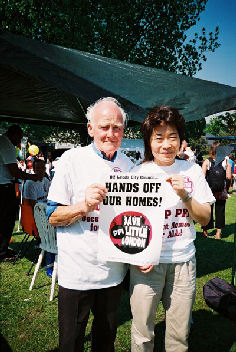 Saturday's annual Community Day in Little London was a huge success. Blessed with beautiful sunshine all day and a nice strong breeze (which caused havoc with the stalls), hundreds of residents turned out and had a brilliant time.
The area was transformed - a giant marquee beating out music, a dozen stalls, a booming barbecue, a giant diversity of people mingling together. It must have been quite a shock for the Council to discover that there really is a community down here. Time and time again they have spoken of the need to 'create' one. Thanks, but no thanks.
The Save Little London Campaign stall went really well and the t-shirts proved a big hit with all ages and sizes. We gave away all 125 and were delighted to see them being worn throughout the day. Loads of new people signed up to find out more about our campaign, 100s of newsletters were distributed and we made some great new friends.
A common theme emerged from our conversations - that people still had no idea what was really going to happen to the estate, despite the Council's 'consultation' exercise, and were really angry to discover that the Lovells were being sold off, and Carlton Towers demolished.
Below are some photos from the day. Let's hope they want become distant memories of what our community used to be.

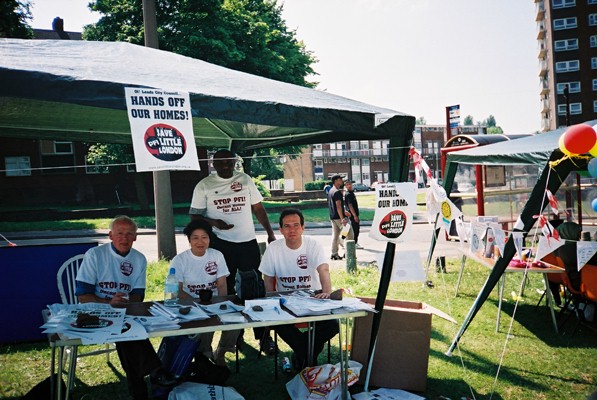

Subscribe to:
Posts (Atom)